A Audemars Piguet Royal Oak is typically worth $15,000 – $100,000, depending on reference, condition, originality, and provenance.
Market values current as of September 2026Introduction: A Watch That Changed Everything
When Audemars Piguet unveiled the Royal Oak in 1972, the Swiss watch industry was in crisis. The quartz revolution had shaken traditional mechanical watchmaking to its core, and few manufacturers knew how to respond. AP's answer was audacious: a luxury sports watch in steel, priced higher than most gold watches of the era, built around a design so radical it defied every convention the industry held dear.
Fifty years later, the Royal Oak is one of the most recognized, most coveted, and most valuable watch references on the secondary market. Prices for steel Royal Oak models routinely reach five and six figures, and rare vintage examples have sold at major auction houses for hundreds of thousands of dollars. Understanding what drives those values — and how to identify authentic, well-preserved examples — is essential knowledge for any serious collector or seller.
This guide covers the full Royal Oak universe: its design history, the key references you need to know, how to identify and authenticate a genuine piece, and a detailed breakdown of current market values as of September 2026.
📖 Related: Patek Philippe Nautilus Value Guide
Gerald Genta and the Design That Broke the Rules
The Royal Oak's origin story is one of watchmaking legend. In 1971, Audemars Piguet approached freelance designer Gerald Genta with a challenge: create a luxury steel sports watch in time for the Basel Watch Fair the following year. According to accounts from Genta himself, the design came to him overnight — inspired by the diving helmets worn by deep-sea divers, secured with a ring of bolts around the porthole.
The result was the reference 5402ST, debuted in April 1972. The watch's key design elements remain instantly recognizable today:
- Octagonal bezel with eight exposed hexagonal screws — purely decorative, but symbolically powerful
- Tapisserie dial — a hobnail (Clous de Paris) pattern pressed into the dial surface, catching light at every angle
- Integrated bracelet — flowing seamlessly from the case, rather than attaching via traditional lug bars
- Ultra-thin profile — the original Jumbo measured just 7mm thick, a technical achievement for its time
- Alternating brushed and polished surfaces — showcasing Audemars Piguet's finishing mastery
The original 5402ST was nicknamed "the Jumbo" by collectors — not an official designation, but one that stuck as later models grew in size. It was powered by the AP caliber 2121, a movement developed jointly with Jaeger-LeCoultre and Patek Philippe (where it powers the Nautilus's equivalent). The Jumbo retailed at 3,300 Swiss francs — more than comparable gold watches at the time — and sold poorly at first. The market would eventually come around in spectacular fashion.
Audemars Piguet is headquartered in Le Brassus, in the Vallée de Joux region of Switzerland, where it has manufactured watches since 1875. The manufacture remains family-controlled and independent, a rarity among top Swiss watchmakers — a fact that resonates with collectors who prize authenticity and heritage.
Key Royal Oak References: A Collector's Guide
Reference 5402ST — The Original Jumbo (1972–1984)
The holy grail of Royal Oak collecting. The 5402ST was produced in small numbers from 1972 to 1984 and came in several dial variants — blue, black, grey, white, and the rare "tropical" examples where the original dial has aged to a distinctive brown. Cal. 2121 movement, 39mm case, 7mm thin. Examples with original dials typically sell for $50,000–$100,000, and very early case numbers or tropical dials can go far higher at auction.
Reference 15202ST — The Modern Jumbo Extra-Thin
Introduced in 2000 as the direct spiritual successor to the 5402, the 15202ST (and its 2022 successor, the 16202ST) maintains the original 39mm case and ultra-thin Cal. 2121 profile. The 16202ST is the most coveted current-production Royal Oak, regularly selling at significant premiums above its approximately $40,100 retail price. Secondary market values: $55,000–$90,000 for a steel 15202ST and $60,000–$90,000 for a 16202ST in excellent condition.
Reference 15400ST and 15401ST — The 41mm Standard
Produced from 2012 to 2019, the 15400 expanded the case to 41mm and introduced the Cal. 3120 automatic. Available in steel (15400ST) and gold variants (15400OR, 15400BA). Steel models are the most liquid on the secondary market. Values: $27,000–$38,000 for steel in excellent condition with box and papers.
Reference 15500ST — The 41mm Flagship (2019–2022)
The 15500 replaced the 15400 in 2019, bringing the new Cal. 4302 movement (with improved power reserve), a redesigned dial with vertical satin-brushed hours, and updated bracelet. The new dial treatment proved divisive among purists but has been embraced by a new generation of collectors. Steel values: $36,000–$48,000 depending on dial color and condition.
Reference 26331 — Royal Oak Chronograph
The Royal Oak Chronograph adds a flyback function and Cal. 2385 movement to the iconic case. Available in 41mm and various materials. Steel examples trade in the $36,000–$50,000 range; gold and complex variants can exceed $70,000.
Royal Oak Offshore — The "Beast"
Designed by Emmanuel Gueit and launched in 1993, the Offshore was conceived as an "oversize" Royal Oak — bigger, bolder, more aggressive. The original reference 25721ST measured 42mm; modern Offshores run 42–44mm. The Offshore has attracted a different collector base from the classic Royal Oak and includes countless limited editions, celebrity collaborations, and exotic material variants. Values range from $15,000 for a basic steel Offshore to $150,000+ for rare limited editions.
Hodinkee's comprehensive history of the Royal Oak reference 5402 provides excellent further reading on the watch's evolution.Royal Oak Identification Guide
Identifying a genuine Royal Oak requires attention to multiple details simultaneously. Counterfeiters have become increasingly sophisticated, making careful inspection essential before any purchase.
The Bezel
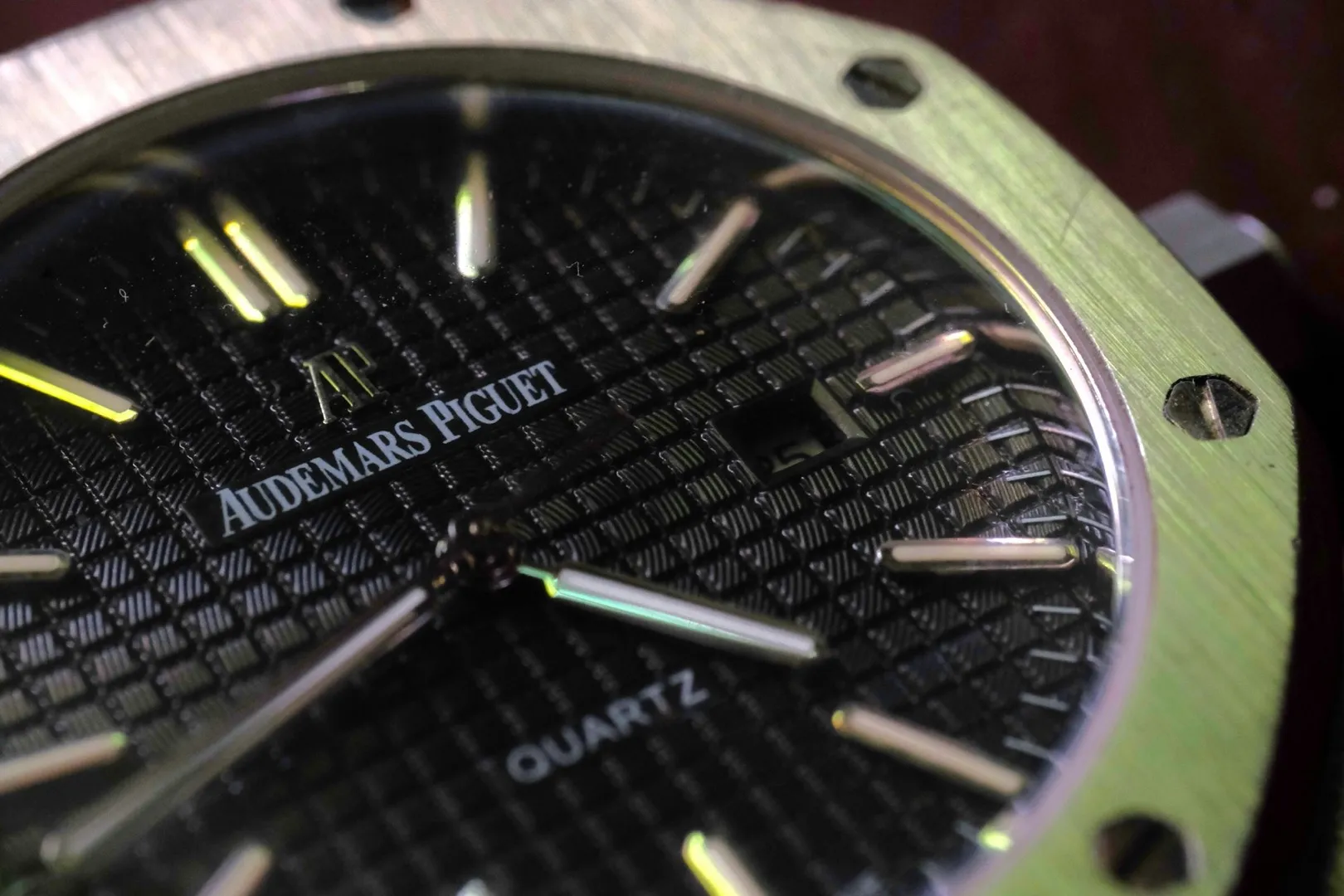
Count the screws: there are always exactly eight hexagonal screws on the octagonal bezel. On genuine AP watches, these screws are perfectly aligned, with consistent gap spacing between each. The screw heads on authentic pieces show precise machining with sharp, clean slots. On fakes, screw alignment is often uneven and the finishing is crude under magnification.
The Tapisserie Dial
The hobnail pattern is one of the most difficult elements to replicate convincingly. On a genuine Royal Oak, each pyramid in the tapisserie pattern is sharp, uniform in height, and catches light with a consistent, three-dimensional sparkle. Fake tapisserie dials tend to be flat, poorly defined, or inconsistent in depth. View the dial at a raking angle under a strong light source — the difference is immediately apparent to a trained eye.
Case and Bracelet Finishing
Audemars Piguet's finishing is among the finest in the industry. The Royal Oak's case and bracelet feature precise alternating brushed (satin) and mirror-polished surfaces. The transition between the two finishes is crisp and clean on authentic pieces. Excessive polishing — common when watches are poorly serviced — eliminates the brushed finish and significantly reduces value. The bracelet links should move fluidly but with no lateral play.
Movement (via Caseback)
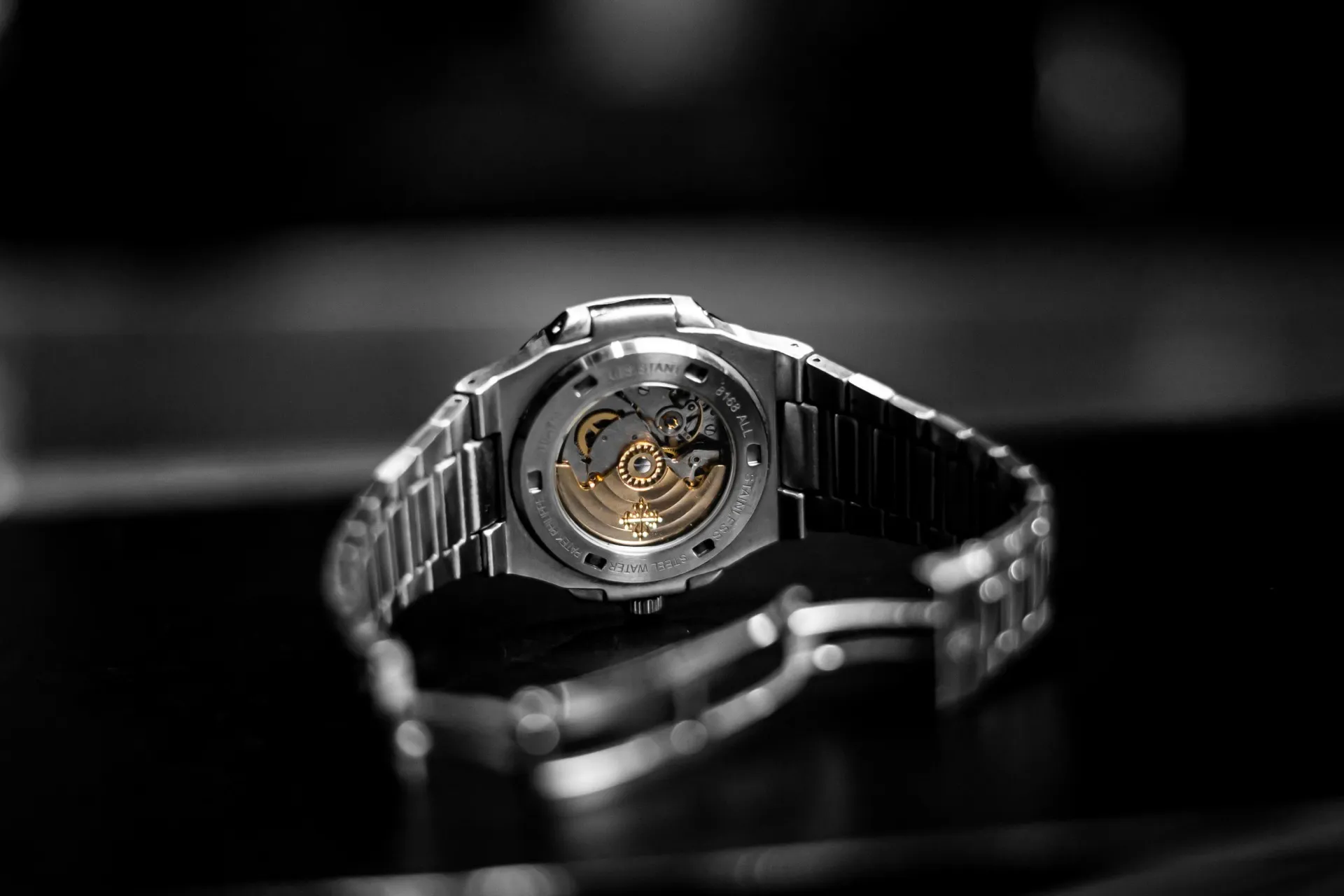
Modern Royal Oaks feature a sapphire exhibition caseback. The movement should be immaculately finished, with beveled bridges, Côtes de Genève (Geneva stripes), and blue steel screws. Verify the caliber matches the expected reference: Cal. 2121 (15202/Jumbo), Cal. 3120 (15400), Cal. 4302 (15500). Any anomaly — wrong caliber, poor finishing, non-AP markings — is a serious red flag.
Value Factors: What Drives Royal Oak Prices
Royal Oak values are determined by a complex interplay of factors. Understanding each helps both buyers and sellers set realistic expectations.
- Reference and generation: Vintage Jumbos and current ultra-thin references command the highest premiums. Entry-level Offshores sit at the lower end.
- Dial color and rarity: Blue and grey are classic; unusual colors (salmon, olive, white, "tropical" aged dials) attract collector premiums of 20-50% or more.
- Case material: Counterintuitively, steel Royal Oaks often carry bigger premiums over retail than gold versions on the secondary market, driven by production scarcity and demand from a new generation of collectors.
- Condition: Unpolished, original-surface examples are substantially more valuable than polished pieces. Service records from AP are a positive signal.
- Completeness: Full set (original box, inner box, papers, hang tags, additional links, tool) adds 10-20% to value.
- Provenance: Celebrity ownership, documented history, AP Extract from the Archives, and auction records all support premium pricing.
Royal Oak Market Prices (September 2026)
The following price ranges reflect secondary market transactions as of September 2026. Prices assume excellent condition with original finish; condition downgrades or missing papers will reduce values accordingly.
| Reference | Description | Case Material | Market Range (USD) | Notes |
|---|---|---|---|---|
| 5402ST | Jumbo Original (1972–1984) | Steel | $50,000 – $100,000+ | Early case numbers and tropical dials go higher; condition critical |
| 15202ST / 16202ST | Jumbo Extra-Thin (Modern) | Steel | $55,000 – $90,000 | Strong premium over ~$40.1K 16202ST retail |
| 15400ST | 41mm (2012–2019) | Steel | $27,000 – $38,000 | Most liquid reference; easy to buy/sell |
| 15400OR | 41mm (2012–2019) | Rose Gold | $45,000 – $60,000 | Lower premium over steel vs. expectation |
| 15500ST | 41mm (2019–2022) | Steel | $36,000 – $48,000 | Blue dial sells for more than black or silver |
| 26331ST | Chronograph 41mm | Steel | $36,000 – $50,000 | Flyback complication; strong demand |
| 25721ST | Offshore Original (1993) | Steel | $20,000 – $45,000 | Growing vintage collector interest |
| Offshore (modern steel) | Various 42–44mm references | Steel | $15,000 – $35,000 | Wide variation by edition and condition |
| Offshore (limited editions) | Celebrity collabs, exotic materials | Various | $35,000 – $150,000+ | Rarity and provenance drive premiums |
Wondering about yours?
Find out what your Audemars Piguet Royal Oak is worth
Upload a photo and get an instant AI valuation with a realistic price range — free, and no account needed.
📖 Related: Rolex Submariner Value Guide
Authentication: Protecting Yourself from Fakes
The Royal Oak's iconic status makes it a prime target for counterfeiters. While crude fakes are easy to spot, high-quality replicas exist that require expert examination to identify. Here are the key steps to authenticate a Royal Oak purchase:
Official Documentation
Request an Audemars Piguet Extract from the Archives. AP maintains detailed production records and can provide official documentation confirming a watch's reference, case material, dial, caliber, and original delivery details. This is the gold standard for provenance verification and is available through AP boutiques and authorized service centers.
Authorized Dealer or Service Center Inspection
Before purchasing any Royal Oak above $10,000, have it inspected by an authorized AP dealer or an independent watchmaker specializing in prestige Swiss watches. AP service centers can verify authenticity and provide a condition assessment.
Movement Verification
Through the sapphire caseback, verify the movement caliber, finishing quality, and AP markings. The caliber should match exactly what is expected for the reference number and production year. Any discrepancy is a red flag that demands explanation.
Reputable Marketplace Platforms
When buying online, use established platforms with authenticity guarantees. Chrono24 offers buyer protection and verification services for Royal Oak transactions and is one of the most liquid global marketplaces for pre-owned examples.
Recent auction results and current prices (September 2026)
Updated September 2026. Prices throughout this guide were reviewed and updated in September 2026.
Since early 2026 the Royal Oak market has moved sideways to slightly up rather than rebounding sharply. WatchCharts data cited by Borro showed the Royal Oak up about 1% in April 2026 and the broader index nearly flat in May, even as Phillips' Geneva Watch Auction XXIII set a record CHF 74.8 million total. The pattern is clear: rare, well-documented pieces beat their estimates, while standard steel references like the 15500ST trade in a narrow band. WatchCharts puts the 15500ST, the most-traded Royal Oak, at roughly $40,000.
Current prices by reference
| Reference | Years | Typical price, Sept 2026 | Notes |
|---|---|---|---|
| 5402ST "A-series" | 1972–1970s | $50,000–$100,000 | Very early case numbers and original dials can go far higher at auction |
| 14790ST | c. 1992–2005 | $25,000–$38,000 | 36mm; trackers put the average near $31,000 |
| 15202ST Jumbo | 2000–2022 | $55,000–$90,000 | Discontinued; late full sets with the blue dial bring the most |
| 15300ST | c. 2005–2012 | $28,000–$40,000 | 39mm; WatchCharts value about $35,000 |
| 15400ST | 2012–2019 | $27,000–$38,000 | 41mm, calibre 3120 |
| 15500ST | 2019–2022 | $36,000–$48,000 | Blue dial sells for more than black or silver |
| 16202ST | 2022–present | $60,000–$90,000 | Retail about $40,100; 2022 "50th Anniversary" rotor examples sell for more |
Recent verified auction results
- 5402 "A-series", case no. 6 (1972): CHF 120,650 including premium, Phillips Geneva Watch Auction XXIII, lot 17, May 2026, against a CHF 80,000–160,000 estimate. Lot result
- 5402ST "A-series", blue dial (c. 1975): HK$384,000 including premium, Sotheby's Fine Watches online sale, Hong Kong, lot 8657, March 2026. Lot result
- 16202ST.OO.1240ST.01 "50th Anniversary" (c. 2022): CHF 115,200 including premium, Sotheby's Fine Watches, Geneva, lot 204, May 2026, against a CHF 30,000–50,000 estimate. Lot result
- 16202BC Jumbo, white gold, blue dial (c. 2023): $127,000, Phillips New York Watch Auction XIV, lot 116, June 2026, estimate $60,000–120,000. Lot result
- 14802ST Jubilee, no. 392 of 1,000 (1992): CHF 48,260, Phillips Geneva Watch Auction XXIII, lot 113, May 2026, near the low end of a CHF 40,000–80,000 estimate. Lot result
Auction records show what a specific watch fetched, not what yours will. Condition, polishing, box and papers, and dial variant can move a Royal Oak's value by 20% or more. For comparison with the other big steel sports watch, see our Patek Philippe Nautilus value guide, or the Calatrava guide for dress watches. To price your own watch, use our watch valuation page, find a specialist in the watch and timepiece directory, or upload a photo for a free photo estimate.
Market Trends: Where Is the Royal Oak Headed Next?
The Royal Oak market experienced dramatic swings between 2020 and 2024. During the pandemic-era watch boom (2020–2022), steel Royal Oak prices reached extraordinary levels — 15202ST references traded at $80,000–$100,000, more than three times retail. The subsequent correction (2023–2024) brought values back to earth, with most steel references settling 20-35% below peak prices.
As of September 2026, the market has largely stabilized, moving sideways to slightly up, at levels that still represent healthy premiums above retail for desirable references. Key trends to watch:
- Vintage strengthening: Original Jumbo (5402) prices have held firm and continue to appreciate as the pool of unpolished, original-dial examples shrinks.
- 15500 finding its level: The 15500 now trades in a narrow band around $40,000 as buyers accept the updated dial design.
- Offshore revival: The original 25721ST and early Offshore references are attracting growing vintage collector interest, with prices firming after years of being overshadowed by the classic Royal Oak.
- Condition premium expanding: The gap between unpolished and polished examples continues to widen as buyers become more sophisticated about originality.
Where to Buy and Sell an Audemars Piguet Royal Oak
Buying
- AP Boutiques: New Royal Oaks are available through authorized AP boutiques, but waitlists for desirable steel references are long — often 1-3 years.
- Authorized Pre-Owned Dealers: Established dealers like Bob's Watches, WatchBox, and Crown & Caliber offer authenticated pre-owned Royal Oaks with warranties.
- Chrono24 and eBay: Largest secondary market volumes, but buyer due diligence is critical. Use escrow services and always verify authenticity before funds transfer.
- Auction Houses: Phillips, Christie's, and Sotheby's hold dedicated watch auctions where rare and vintage Royal Oaks achieve the highest documented prices.
Selling
- Direct to dealer: Fast and certain, but expect 15-25% below retail secondary market price.
- Consignment with established dealers: Higher net proceeds, typically 80-90% of sale price, with the dealer handling authentication and marketing.
- Auction: Best for rare, high-value, or provenance-rich pieces. Buyer's premiums (typically 15-25%) are paid by the buyer, but seller's commissions apply.
- Private sale via Chrono24: Maximum proceeds but maximum effort — you handle listing, communication, and shipping logistics.
📖 Related: How to Authenticate a Luxury Watch Before Buying
Frequently Asked Questions
How much is an Audemars Piguet Royal Oak worth?
Depending on the reference, condition, and dial color, Royal Oak watches typically sell for about $15,000 to over $100,000. Steel Jumbo references like the 15202 and 16202 command the highest premiums on the secondary market. Gold models and special editions can exceed $250,000 at auction.
What makes the Royal Oak so valuable?
The Royal Oak redefined luxury sports watches when Gerald Genta designed it in 1972. Its integrated bracelet, octagonal bezel with eight exposed hexagonal screws, and finely finished tapisserie dial set it apart. Limited production numbers, strong brand prestige, and consistent collector demand keep values high.
Which Royal Oak reference is the most collectible?
The reference 5402ST — the original "Jumbo" — is the most historically significant and commands the highest collector premiums. Among modern pieces, the 15202ST and 16202ST (Jumbo Extra-Thin) and the 15500ST are the most sought-after steel references.
How can I tell if a Royal Oak is authentic?
Key authentication markers include the quality of the tapisserie (hobnail) dial pattern, the symmetry and finishing of the eight hexagonal bezel screws, the brushed and polished contrast finishing on the case and bracelet, and the movement visible through the sapphire caseback. Always verify the serial number with Audemars Piguet and buy from reputable dealers.
Does the Royal Oak hold its value over time?
Steel Royal Oak references have historically outperformed retail price appreciation over the long term, often trading at significant premiums above list. However, the market corrected in 2023-2024 after pandemic-era highs, and values have since stabilized, moving sideways to slightly up through 2026. Gold and titanium references tend to retain value but without the same secondary-market premium as steel sports models.
How to Value a Audemars Piguet Royal Oak: Step by Step
-
Identify the Reference Number
Locate the reference number on the caseback or between the lugs (visible when the bracelet is removed). Cross-reference against known Royal Oak references such as 15202, 15400, 15500, 26331, or the original 5402. The reference determines both the generation and approximate value range.
-
Assess the Dial Condition
Examine the tapisserie dial under good lighting for fading, moisture damage, repainting, or scratches. An original, unrestored dial in excellent condition is critical — a refinished dial can reduce value by 20-40%. Look for even, crisp hobnail texture and sharp printed text.
-
Inspect the Case and Bracelet
The Royal Oak's case and bracelet feature alternating brushed and polished surfaces. Excessive polishing that removes the brushed finish is a red flag that reduces value. Check the bezel screws for correct alignment and original finishing — all eight should be uniform.
-
Verify the Movement
The sapphire caseback reveals the movement. Familiarize yourself with the caliber expected for the reference (e.g., Cal. 3120 in the 15400, Cal. 4302 in the 15500). Look for a clean, unmodified movement with no signs of unauthorized servicing or parts replacement.
-
Check Provenance and Papers
Original box and papers (full set) can add 10-20% to resale value. Request a service history and, where possible, an AP Extract from the Archives confirming the watch's production details. For vintage pieces, research auction records and any published references.
What Drives the Value
- Reference and Generation: The original 5402ST Jumbo and the 15202ST and current 16202ST Jumbos command the highest premiums; entry-level references like the 15400 sit at the lower end of the price spectrum.
- Dial Color and Rarity: Classic blue and grey tapisserie dials are standard; special or limited-edition dials in unusual colors (salmon, olive, white) attract significant collector premiums.
- Case Material: Steel sports models paradoxically command higher secondary-market premiums than gold versions due to lower production numbers and stronger collector demand.
- Condition: Unpolished, original-finish cases and bracelets with minimal wear are worth substantially more than heavily polished or damaged examples.
- Completeness: Full set (box, papers, hang tags, warranty card) can add 10-20% above watch-only prices, particularly for modern references.
- Provenance and Service History: Documented ownership history, AP service records, and Extract from the Archives certificates all support higher valuations and buyer confidence.
Identification Checklist
- Count the bezel screws — an authentic Royal Oak always has exactly eight hexagonal screws on the octagonal bezel, symmetrically spaced.
- Study the tapisserie dial pattern: the hobnail texture should be perfectly uniform, with consistent depth and sharp edges. Poorly executed dials are a common counterfeit tell.
- Check the case finishing: authentic Royal Oaks display a precise contrast between brushed (satin) and mirror-polished surfaces on the case sides, lugs, and bracelet links.
- Inspect the crown — the Royal Oak uses a small, integrated crown that sits flush with the case. On fakes, the crown is often oversized or poorly finished.
- On modern references, the integrated folding clasp should operate smoothly with a solid, high-quality click. Flimsy or rough clasps indicate a non-genuine piece.
How to Spot a Fake
- Request an Audemars Piguet Extract from the Archives — AP provides official documentation confirming a watch's production details including reference, case material, dial, and delivery date.
- Verify the movement caliber through the sapphire caseback against the expected caliber for that specific reference year. Any discrepancy warrants further investigation.
- Use a loupe or macro photography to examine the tapisserie dial: counterfeit dials often have irregular, shallow, or machine-stamped texture that lacks the depth of a genuine AP dial.
- Confirm the serial number format and range is consistent with the reference's known production period — AP serial records are maintained and can be cross-checked through authorized dealers.
- Have the watch tested by an authorized Audemars Piguet service center or a reputable independent watchmaker specializing in prestige Swiss watches before any significant purchase.