Jewelry is one of the most commonly inherited, gifted, and collected categories of personal property — and one of the most misunderstood when it comes to value. A ring that cost $5,000 at a mall jeweler might be worth $1,500 on resale, while a vintage brooch picked up at an estate sale for $20 could turn out to be worth $2,000.
Understanding how jewelry is valued gives you the power to make informed decisions when buying, selling, insuring, or simply appreciating what you own. This guide walks you through every factor that determines jewelry value — from the raw materials to the craftsmanship, brand, era, and current market dynamics.
How Jewelry Is Valued
Jewelry valuation is not a single formula. It is the convergence of multiple factors, each weighted differently depending on the piece and the market. An appraiser evaluating a diamond engagement ring considers very different criteria than one assessing a Georgian mourning brooch or a mid-century Trifari necklace.
Materials: The Foundation of Value
The intrinsic material value — the melt value of the metal and the wholesale value of the stones — forms the baseline. For gold and platinum jewelry, this baseline is directly tied to commodity markets. For gemstone jewelry, the quality, size, and type of stones establish a floor price.
However, intrinsic material value is almost always less than the retail or collectible value of a finished piece. The gap between melt value and market value is where craftsmanship, design, and desirability live.
Craftsmanship and Design
How a piece is made matters enormously. Hand-fabricated jewelry from a master goldsmith commands a premium over mass-produced cast pieces, even when the materials are identical. Specific techniques — filigree, granulation, channel setting, pavé work, enamel — add value when executed with skill.
Design also matters independently of technique. A piece by a recognized designer or from a notable design period (Art Deco, Art Nouveau, Mid-Century Modern) carries a premium based on aesthetic desirability and historical significance.
Brand and Maker
As with watches, brand is a major value driver in jewelry. A simple gold chain from Cartier is worth more than an identical-weight chain from an unknown maker. The premium varies by brand:
- Top tier: Cartier, Van Cleef & Arpels, Tiffany & Co., Bulgari, Harry Winston — strong resale, often 40-70% of retail
- High-end designer: David Yurman, John Hardy, Buccellati — moderate resale, 25-50% of retail
- Mall/fashion brands: Pandora, Kay Jewelers, Zales — minimal resale premium, often near melt value
For vintage and antique jewelry, the maker's mark is particularly important. Signed pieces by firms like Georg Jensen, Lalique, or Fabergé can be worth many times their material value.
Provenance and History
A piece with documented history — especially one connected to a notable owner, event, or collection — can command a significant premium. Even without celebrity connections, a clear chain of ownership and original purchase documentation add buyer confidence and value.
For antique jewelry, provenance helps establish authenticity and period accuracy, which is critical for pieces where condition and originality drive the premium.
Inherited jewelry? Read our complete guide: How to Value Inherited Jewelry Without Getting Ripped Off
Gold and Silver: Understanding Purity and Market Value
Precious metals form the backbone of most fine jewelry, and understanding purity markings is the first step in any valuation. The value of gold and silver jewelry starts with its metal content, which fluctuates daily based on commodity markets.
Gold Karat Purity
Gold purity is measured in karats (not to be confused with carats, which measure gemstone weight). Pure gold is 24 karat, but pure gold is too soft for most jewelry. It is alloyed with other metals — copper, silver, zinc, palladium — to increase durability and alter color.
| Karat | Gold Purity | Gold Content | Common Use | Hallmark |
|---|---|---|---|---|
| 24K | 99.9% | Pure gold | Investment bars, some Asian jewelry | 999 |
| 22K | 91.7% | 22 parts gold, 2 parts alloy | Indian/Middle Eastern jewelry | 916 |
| 18K | 75.0% | 18 parts gold, 6 parts alloy | Fine jewelry standard (Europe, luxury brands) | 750 |
| 14K | 58.3% | 14 parts gold, 10 parts alloy | Most popular in the US | 585 |
| 10K | 41.7% | 10 parts gold, 14 parts alloy | Minimum legal standard in the US for "gold" | 417 |
| 9K | 37.5% | 9 parts gold, 15 parts alloy | Common in the UK and Australia | 375 |
To estimate melt value, weigh the piece in grams, multiply by the karat fraction (e.g., 14/24 = 0.583 for 14K), then multiply by the current gold spot price per gram. Check Kitco for live gold prices. This gives you the floor value — what a refiner would pay. Retail and collectible values will be higher.
Silver Purity
Silver jewelry typically comes in two grades:
- Sterling silver (925): 92.5% pure silver, 7.5% copper alloy. The global standard for silver jewelry and flatware. Look for "925," "Sterling," or a lion passant hallmark (UK).
- Fine silver (999): 99.9% pure silver. Softer and less common in jewelry. Sometimes used for pendants or earrings where durability is less critical.
Silver is far less valuable by weight than gold — roughly 1/80th the price — so silver jewelry's value is more heavily influenced by craftsmanship, design, and maker than by metal content alone. A Georg Jensen silver brooch from the 1940s can be worth $500-$2,000, while its melt value might be $15-$30.
Selling inherited gold or silver? Don't leave money on the table: How to Sell Inherited Gold and Silver Without Getting Lowballed
Have silverware you're not sure about? See: Inherited Silverware: How to Tell If It's Sterling and What It's Worth
Gold-Plated, Gold-Filled, and Vermeil
Not all "gold" jewelry contains significant gold. Understanding the terminology prevents costly mistakes:
- Solid gold: The piece is gold throughout (10K-24K). This is what holds real metal value.
- Gold-filled (GF): A thick layer of gold mechanically bonded to a base metal. Must be at least 1/20th gold by weight. More durable than plating and has some gold value, though minimal.
- Gold-plated (GP): A thin electroplated layer of gold over base metal. Negligible gold content. Value comes from design and brand, not metal.
- Vermeil: A thick layer of gold (at least 2.5 microns) over sterling silver. More valuable than gold-plated because of the silver base, but still primarily valued for design.
Gemstone Valuation Basics
Gemstones add the most variable element to jewelry valuation. Two diamonds that look identical to the naked eye can differ in value by thousands of dollars based on subtle quality differences. Understanding the fundamentals helps you evaluate what's in your jewelry box — or what you're considering purchasing.
The 4 Cs of Diamond Valuation
The Gemological Institute of America (GIA) established the 4 Cs system, which remains the global standard for diamond grading:
- Carat: Weight measurement (1 carat = 0.2 grams). Price per carat increases exponentially with size — a 2-carat diamond is worth far more than twice the price of a 1-carat diamond of the same quality.
- Cut: How well the diamond has been shaped and faceted. Cut affects brilliance more than any other factor. Grades range from Excellent to Poor. An Excellent cut diamond will outperform a higher-clarity or higher-color stone with a mediocre cut.
- Color: Graded D (colorless) through Z (light yellow/brown). The differences between adjacent grades (e.g., G vs. H) are nearly invisible to the naked eye but meaningful in price. Most experts recommend G-H color as the best value.
- Clarity: The presence of internal inclusions and surface blemishes. Grades range from Flawless (FL) to Included (I3). VS1-VS2 (Very Slightly Included) offers the best balance of quality and value — inclusions are invisible without magnification.
A GIA or AGS (American Gem Society) grading report is essential for any diamond over 0.5 carats. Without an independent lab report, you are relying on the seller's assessment — which may be optimistic. A grading report costs $50-$150 and can save you thousands by confirming actual quality.
Colored Gemstones: Beyond the 4 Cs
For rubies, sapphires, emeralds, and other colored stones, the 4 Cs apply differently. Color is the dominant value factor — a richly saturated ruby with moderate inclusions is far more valuable than a perfectly clean but pale one.
Additional factors for colored stones include:
- Origin: Where a stone was mined affects value significantly. Kashmir sapphires, Burmese rubies, and Colombian emeralds command premiums over stones from other locations, even when quality is comparable.
- Treatment: Most colored gemstones are treated to enhance color or clarity. Heat treatment is widely accepted and has minimal impact on value. However, fracture filling, diffusion, or heavy oiling significantly reduces value. An untreated stone of fine quality is worth 2-10x more than a treated equivalent.
- Phenomena: Optical effects like star sapphires (asterism), cat's eye chrysoberyl (chatoyancy), or alexandrite's color change add significant value when well-displayed.
Gemstones That Surprise People
Not all valuable stones are diamonds, rubies, or sapphires. Several lesser-known gems command strong prices:
- Alexandrite: Fine color-change examples can exceed $30,000 per carat — more expensive than most diamonds.
- Paraiba tourmaline: Neon blue-green stones from Brazil can reach $20,000-$50,000 per carat.
- Padparadscha sapphire: The rare pink-orange variety commands $10,000-$30,000 per carat for fine examples.
- Demantoid garnet: Russian examples with "horsetail" inclusions are highly prized, reaching $3,000-$10,000 per carat.
- Jadeite: Imperial green jadeite (not nephrite) can be worth more per carat than diamond. Fine jadeite bangles have sold for millions at auction.
Vintage & Antique Jewelry: What Makes It Special?
Age alone does not make jewelry valuable — but age combined with quality, design, and historical context creates pieces that are worth far more than their material components. Understanding the major jewelry periods helps you identify what you have and what it might be worth.
Major Jewelry Periods
- Georgian (1714-1837): Extremely rare. Hand-fabricated, often set with rose-cut diamonds or colored stones in closed-back settings. Even modest Georgian pieces command premiums due to scarcity.
- Victorian (1837-1901): Diverse styles across Early (romantic motifs), Mid (mourning jewelry), and Late (aesthetic movement) periods. Lockets, cameos, seed pearl work, and garnet jewelry are characteristic.
- Art Nouveau (1890-1910): Flowing organic forms, enamel work, and unconventional materials (horn, glass, plique-à-jour enamel). Pieces by René Lalique are museum-worthy and command five- to six-figure prices.
- Edwardian (1901-1915): Platinum and diamonds in delicate, lacy designs. Garland-style necklaces, tiaras, and brooches. Light and airy craftsmanship.
- Art Deco (1920-1939): Geometric patterns, bold color contrasts, and architectural forms. One of the most collected periods. Fine Art Deco pieces by Cartier, Van Cleef, or Boucheron are among the most valuable jewelry on the secondary market.
- Retro/Mid-Century (1940-1960): Bold, oversized designs in rose and yellow gold. Tank bracelets, cocktail rings, and statement brooches. Increasingly collected.
When evaluating antique jewelry, originality is critical. Pieces with original stones, clasps, and metalwork are worth significantly more than those that have been altered or repaired with modern materials. Even well-intentioned repairs can reduce value if they compromise the piece's period authenticity.
How to Date Antique Jewelry
Several clues help identify a piece's era:
- Clasp type: C-clasps and trombone clasps predate 1900. Safety catches became standard after 1910. Modern lobster clasps appeared in the 1970s.
- Metal marks: Platinum wasn't commonly marked until the 1920s. White gold replaced platinum during WWI and WWII due to platinum restrictions.
- Stone cutting: Old mine cuts and old European cuts predate 1900. Transitional cuts date to 1920-1940. Modern brilliant cuts became standard after 1950.
- Construction: Hand-fabricated (file marks, slight irregularities) suggests pre-1940s. Cast pieces with uniform surfaces suggest post-1950s production.
Costume Jewelry That's Actually Valuable
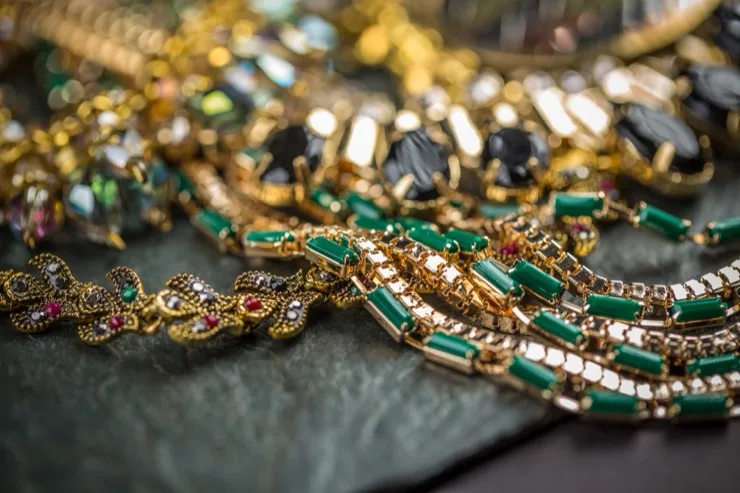
Costume jewelry — pieces made from non-precious materials — is often dismissed as worthless. That's a mistake. Certain costume jewelry commands prices that rival fine jewelry, and the market for vintage designer costume pieces has grown substantially.
| Brand/Maker | Era | Typical Value Range | What Drives Value |
|---|---|---|---|
| Chanel | 1920s-present | $200 - $5,000+ | Early Gripoix glass pieces, CC logo items. Vintage 1960s-80s most collected. |
| Trifari | 1930s-1960s | $50 - $2,500 | "Crown Trifari" mark, jelly bellies, figural brooches, sterling vermeil pieces. |
| Miriam Haskell | 1930s-1960s | $100 - $3,000 | Hand-wired baroque pearl pieces. Intricate, labor-intensive construction. |
| Eisenberg | 1930s-1970s | $75 - $1,500 | "Eisenberg Original" (pre-1945) pieces with large rhinestones most valuable. |
| Schiaparelli | 1930s-1970s | $200 - $4,000 | Surrealist designs, aurora borealis stones, unusual color combinations. |
| Weiss | 1940s-1970s | $40 - $800 | High-quality Austrian rhinestones. Black diamond and smoky gray sets most sought after. |
| Hattie Carnegie | 1920s-1970s | $75 - $2,000 | Figural pieces, Asian-inspired designs. Sterling pieces from 1940s war era premium. |
| Bakelite (various makers) | 1930s-1940s | $50 - $5,000+ | Carved bangles, figural pins. Color and complexity drive value. Philadelphia bracelets can exceed $3,000. |
Always check costume jewelry for maker's marks on clasps, pin backs, and earring clips. An unsigned Trifari brooch might sell for $30, while the same design with a clear "Crown Trifari" mark could bring $300+. Marks are often tiny and require a magnifying glass to read.
Deep dive into costume jewelry values: Vintage Costume Jewelry Value Guide: Hidden Gems in Your Jewelry Box
Where to Get Jewelry Appraised
If you need a formal valuation — for insurance, estate settlement, divorce, donation, or pre-sale — choosing the right appraiser matters. Not all appraisals are equal, and the wrong one can cost you significantly.
Types of Appraisals
- Insurance (replacement value): The cost to replace the item with a comparable piece at current retail prices. This is typically the highest valuation and is what insurance companies use to set coverage.
- Fair market value: What a willing buyer would pay a willing seller, with both having reasonable knowledge. Used for estate tax, donations, and equitable distribution. Usually 40-60% of insurance replacement value.
- Liquidation value: What the piece would bring at a quick sale — auction, pawn shop, or estate liquidator. Typically the lowest valuation, often 20-40% of retail.
How to Choose an Appraiser
Look for these credentials:
- GIA Graduate Gemologist (GG): The gold standard for gemological training. Indicates comprehensive knowledge of gem identification and grading.
- ASA (American Society of Appraisers): Requires demonstrated competency, ethics pledge, and continuing education. ASA-accredited appraisers follow Uniform Standards of Professional Appraisal Practice (USPAP).
- AGS Certified Gemologist Appraiser: Combines gemological expertise with appraisal methodology. Particularly strong for diamond-focused appraisals.
Never use an appraiser who charges a percentage of the appraised value — this creates a conflict of interest. Reputable appraisers charge a flat fee or hourly rate, typically $50-$150 per piece for standard items, and $200-$500+ for complex or high-value pieces.
Online vs. In-Person Appraisal
Online appraisals based on photographs can provide useful preliminary estimates, but they have limitations. A photo cannot reveal the quality of a stone's cut, detect treatments, or accurately assess condition. For any piece potentially worth over $1,000, an in-person appraisal with physical examination is worth the investment.
That said, AI-powered tools like Estimonia are excellent for initial screening — helping you quickly determine which pieces are worth the cost of a full professional appraisal and which are likely worth only their material value.
Red Flags When Selling Jewelry
If you decide to sell, watch out for these common pitfalls:
- Pawn shops offering "top dollar": Pawn shops typically offer 30-50% of fair market value. Acceptable for quick cash but never the best return.
- "We buy gold" storefronts: These operations focus on melt value and ignore craftsmanship, design, or collectibility. A $3,000 designer ring might get a $200 offer based on gold weight alone.
- Consignment shops with vague terms: Get the commission structure, minimum sale period, insurance coverage, and return policy in writing before consigning anything.
- Unsolicited offers: If someone approaches you to buy jewelry — especially after an estate or moving sale — get an independent appraisal first. Legitimate buyers don't pressure sellers.
Planning to sell gold or silver jewelry? Protect yourself: How to Sell Inherited Gold and Silver Without Getting Lowballed
Caring for Jewelry to Preserve Value
How you store and maintain jewelry directly affects its long-term value. Poor storage can cause scratches, tarnish, and even structural damage that diminishes both the appearance and the resale price of a piece.
- Store pieces separately: Diamonds can scratch gold, and harder stones can damage softer ones. Use individual pouches, compartmentalized boxes, or anti-tarnish cloth wraps.
- Remove jewelry during activities: Chlorine (pools, cleaning products), impact (sports, gardening), and chemicals (lotions, perfumes) can damage metals and stones.
- Clean gently: Warm water, mild dish soap, and a soft brush work for most gold and diamond jewelry. Avoid ultrasonic cleaners for emeralds, opals, pearls, and any stone with fracture filling.
- Inspect regularly: Check prongs, clasps, and settings every 6-12 months. A loose prong can mean a lost stone — and a lost stone can mean a dramatic loss in value.
- Keep documentation: Original receipts, appraisals, grading reports, and repair records all contribute to a piece's documented history and add value at resale.
Also relevant: How to Value Inherited Jewelry Without Getting Ripped Off
Final Thoughts
Jewelry valuation sits at the intersection of material science, art history, market dynamics, and personal sentiment. A piece's worth is never just about the gold or the stones — it's about the design, the maker, the era, the condition, and the story it tells.
Whether you're evaluating a diamond solitaire, a vintage Art Deco brooch, a collection of costume jewelry from your grandmother's dresser, or a gold chain you're considering selling, the principles are the same: understand the materials, assess the craftsmanship, research the market, and get professional help when the stakes are high.
The most expensive mistake in jewelry valuation isn't overpaying — it's selling something valuable for a fraction of its worth because you didn't know what you had. Take the time to learn, and you'll make better decisions every time.
For a quick estimate, try Estimonia — snap a photo of your jewelry and get an instant value range with confidence levels.
Frequently Asked Questions
Professional jewelry appraisals typically cost $50-$150 per piece for standard items like rings, necklaces, and bracelets. Complex pieces with multiple gemstones or high-value items may cost $200-$500. Most appraisers charge a flat fee or hourly rate. Avoid any appraiser who charges based on a percentage of the appraised value, as this creates a conflict of interest that can inflate your appraisal or undermine its credibility.
It depends on the piece. Mass-produced gold jewelry without gemstones or designer attribution is often worth close to melt value on the secondary market — typically 80-95% of the gold content value. However, signed designer pieces (Cartier, Tiffany, etc.), antique jewelry, and pieces with significant gemstones are almost always worth more than melt value. Before selling to a gold buyer, always check whether the design, maker, or era adds a premium beyond the metal content.
There are several at-home tests, though none are definitive. The fog test: breathe on the stone — a real diamond disperses heat quickly and won't stay fogged for more than 1-2 seconds. The newspaper test: place the stone face-down on printed text — a real diamond refracts light so much you cannot read through it. The water test: drop the loose stone in water — real diamonds sink quickly due to high density. However, these tests have limitations and can be fooled by high-quality simulants like moissanite. For any stone of significant value, a professional gemological test is the only reliable method.
In the jewelry trade, "antique" generally refers to pieces that are 100 years old or more — so currently, anything made before the mid-1920s. "Vintage" refers to pieces that are at least 20-30 years old but less than 100 years old. "Estate jewelry" is a broader term that simply means previously owned, regardless of age. These distinctions matter for valuation because antique pieces carry premiums for historical significance, rarity, and craftsmanship techniques no longer commonly used.
Generally, no — or at most, only a very gentle cleaning. For antique and vintage jewelry, patina (the natural aging of metal surfaces) can be a positive feature that confirms age and authenticity. Aggressive cleaning, polishing, or chemical dipping can remove this patina and damage delicate surfaces, reducing both the aesthetic appeal and the value. If the piece is extremely dirty, a gentle soak in warm water with mild soap and a soft brush is safe for most metals and stones, but avoid ultrasonic cleaners and chemical solutions until after the appraisal.