A Rolex Datejust is typically worth $4,000 – $60,000, depending on reference, condition, originality, and provenance.
Market values current as of September 2026The Rolex Datejust: An Icon Since 1945
When Rolex introduced the Datejust in 1945 to mark the company's 40th anniversary, it created the first wristwatch to display the date in a magnified window, changing automatically at midnight. That innovation — the cyclops lens combined with the instant date mechanism — defined a category and launched one of the most enduring watch dynasties in history.
Today, the Datejust is Rolex's most recognizable model and one of the most actively traded watches on the pre-owned market. Whether you inherited a two-tone 1980s example or own a modern Datejust 41, this guide provides the foundation to understand its value.
📖 Related: Complete Watch Valuation Guide — understand the fundamentals of watch valuation.
Datejust Reference Guide: Sizes, Eras, and Values
The table below covers the most commonly traded Datejust references and their approximate September 2026 market values. Prices assume good to excellent condition.
| Reference / Variant | Size | Material | Approx. Pre-Owned Value |
|---|---|---|---|
| 1601 / 1603 (1960s-70s vintage) | 36mm | Oystersteel | $4,000–$7,000 |
| 1601 with pie pan dial | 36mm | Oystersteel | $6,000–$12,000 |
| 16013 / 16233 (1980s two-tone) | 36mm | Steel & Gold | $4,500–$8,000 |
| 116200 / 116234 (c. 2004-2018) | 36mm | Oystersteel | $6,000–$11,000 |
| 126200 / 126234 (current 36mm) | 36mm | Oystersteel | $7,500–$13,500 |
| 126334 Datejust 41 (steel) | 41mm | Oystersteel | $11,000–$15,000 |
| 126334 with Wimbledon dial | 41mm | Oystersteel | $13,000–$18,000 |
| Datejust in 18k Yellow Gold | 36/41mm | 18k Gold | $18,000–$40,000 |
| Datejust in Platinum | 36mm | Platinum | $30,000–$60,000 |
Wondering about yours?
Find out what your Rolex Datejust is worth
Upload a photo and get an instant AI valuation with a realistic price range — free, and no account needed.
Vintage Datejust (Pre-1990)
The vintage Datejust market has seen renewed interest, particularly for unique dial variants. The "pie pan" dial — a concave design with a raised outer chapter ring found on 1950s-1970s references — has become a collector obsession. Well-preserved examples can command double the price of standard flat-dial versions. "Tropical" dials that have aged from black to rich brown are equally prized.
Two-Tone Renaissance
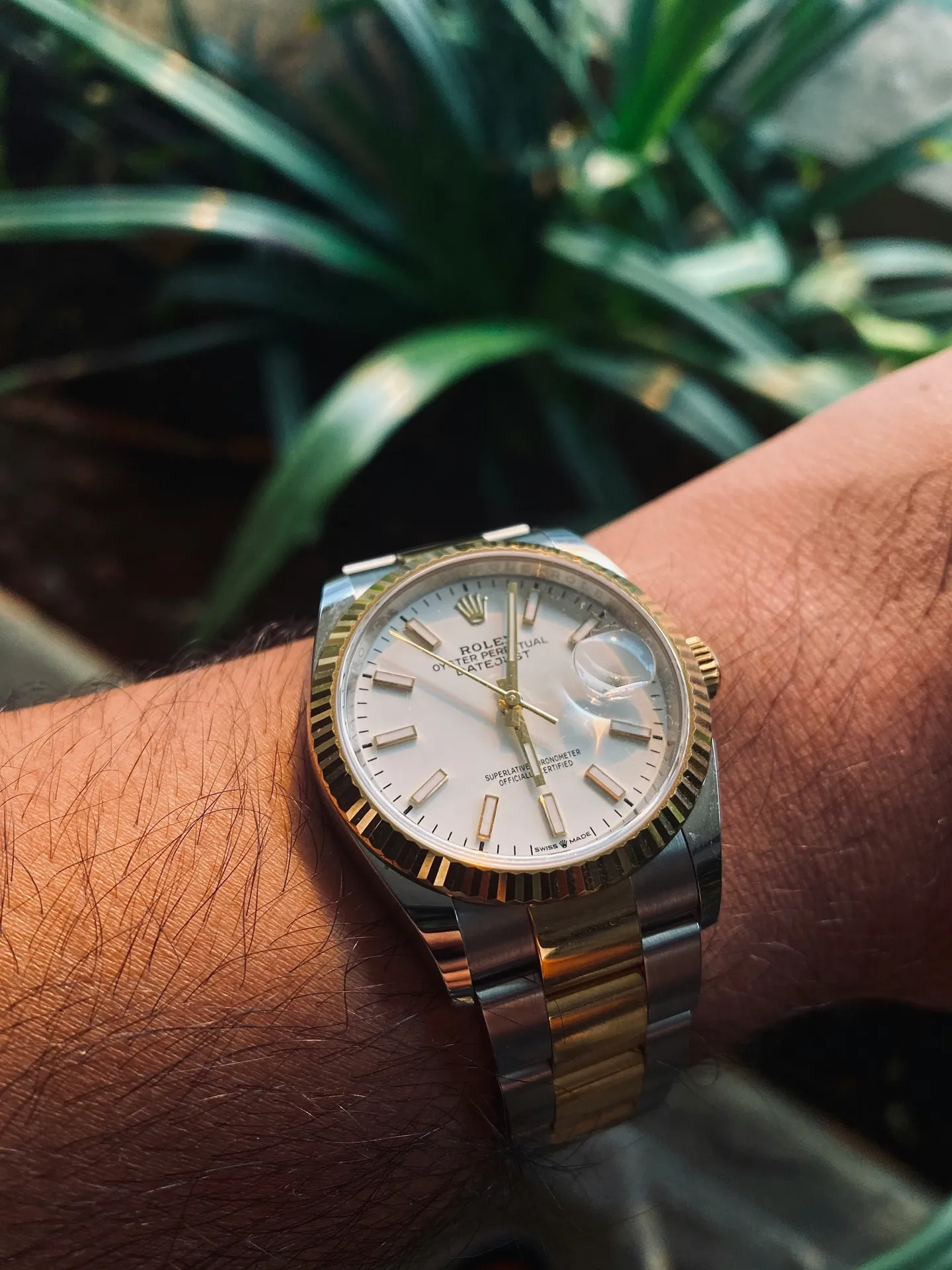
Two-tone Datejusts combining steel with 18k yellow gold were the quintessential 1980s luxury accessory. After years of being unfashionable, they've made a dramatic comeback. A well-preserved 16233 from the 1990s with box and papers now sells for $6,500-$8,500, up from approximately $4,500 five years ago.
Modern Datejust (2016-Present)
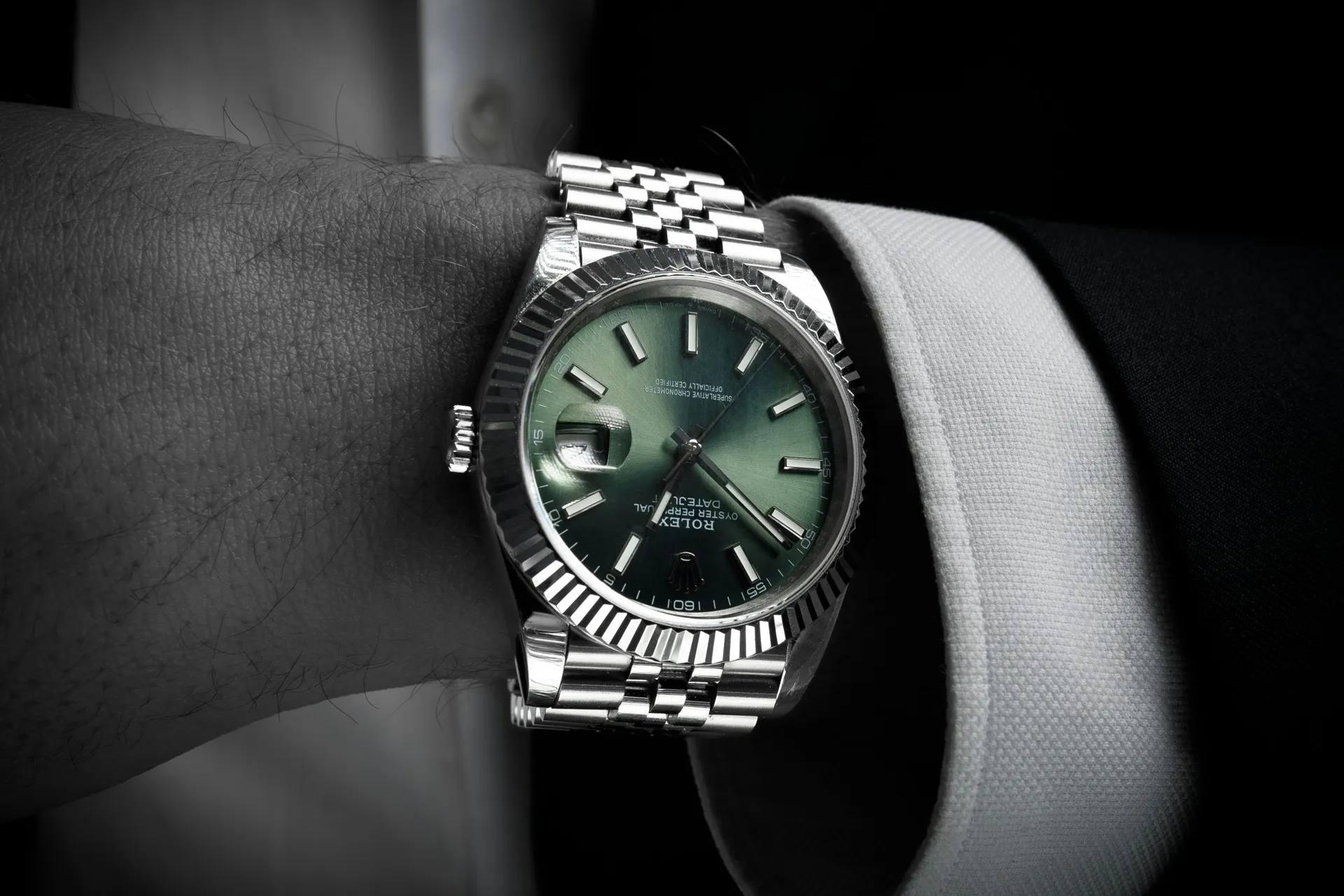
Current production references (126200, 126234, 126334) feature the caliber 3235 with 70-hour power reserve and updated Oyster clasp. The Wimbledon dial — grey with green Roman numerals — has emerged as the most sought-after modern variant, trading above retail on the secondary market.
What Drives Datejust Value?
Dial Is Everything
More than any other Rolex model, the Datejust's value is driven by its dial variant. With hundreds of color and configuration options produced over 80 years, certain combinations create significant premiums. Wimbledon dials, fluted motif dials, and rare factory stone dials can add 30-100% to the base value of a reference.
Bezel and Bracelet Combination
The fluted bezel in white or yellow gold paired with a Jubilee bracelet is the classic Datejust configuration and generally commands the highest prices. The smooth bezel with Oyster bracelet offers a sportier aesthetic at typically lower price points. Diamond-set bezels appeal to a specific market segment and can command premium prices when factory-original.
Condition and Originality
A Datejust that has been heavily polished — where the sharp case edges have been rounded — loses 20-30% of collector value. Original, unpolished surfaces with honest wear are vastly preferred. Similarly, refinished dials are worth significantly less than originals, even if the original shows minor age spots.
📖 Related: Rolex Submariner Value Guide — compare values across Rolex's sport watch lineup.
Authentication Essentials
The Datejust is heavily counterfeited due to its popularity. Key checks include the cyclops magnification (2.5x on genuine, often only 1.5x on fakes), the weight and feel of the Oyster case, the smoothness of the seconds hand sweep, and the precision of the crown operation. For any Datejust valued above $5,000, professional authentication is recommended.
Rolex-authorized service centers can verify authenticity, and independent watchmakers with Rolex expertise offer authentication services typically ranging from $50-$150. Find your nearest Rolex service center for the most authoritative verification.
Recent auction results and current prices (September 2026)
Updated September 2026. Prices throughout this guide were reviewed and updated in September 2026.
The Datejust market is steady, not booming. WatchCharts' Rolex Datejust Market Index, which tracks the 30 most-traded models, stood at about $10,800 on September 21, 2026. That is up roughly 6% over twelve months, and it moved within a narrow band of about $10,150 to $10,850 all year. Vintage steel and two-tone references still change hands every day, so prices for ordinary examples are predictable. Condition, the dial and the paperwork decide where a watch lands within its range.
Current prices by reference
| Reference | Years | Typical price, Sept 2026 | Notes |
|---|---|---|---|
| 1601 (steel) | c. 1959–1977 | $4,000–$7,000 | Dealers ask $4,500 and up. Solid gold versions and rare dials sell for well above this. |
| 16013 (two-tone) | c. 1977–1988 | $4,500–$6,500 | WatchCharts market price was about $5,675 at the end of August 2026. |
| 16014 (steel, white gold bezel) | c. 1977–1988 | $5,000–$7,000 | WatchCharts fair value was about $5,800 on September 1, 2026. |
| 16233 (two-tone) | c. 1988–2004 | $5,500–$8,000 | Box and papers add roughly $500–$1,500. |
| 16234 (steel, white gold bezel) | c. 1988–2004 | $5,000–$7,500 | WatchCharts market price was about $7,000 in August 2026. |
| 116234 | c. 2004–2018 | $7,500–$11,000 | Market price was about $9,200 in August 2026. |
| 126334 (Datejust 41, fluted) | 2016–present | $11,000–$15,000 | US retail is about $11,650. Popular dials sell above retail. |
| 126300 (Datejust 41, smooth) | 2016–present | $9,000–$11,000 | US retail is about $8,950. Blue and green dials sell at the top of the range. |
Recent verified auction results
All six sales below are from Antiquorum. The US dollar figures are approximate conversions.
- Ref. 1601, steel, silver linen dial, c. 1978: HKD 32,500 (about $4,150), Antiquorum Hong Kong, May 2026. Lot result
- Ref. 1601, steel, 1967, with box, guarantee and service papers: HKD 40,000 (about $5,100), Antiquorum Hong Kong, May 2026. It sold at the top of its estimate. Lot result
- Ref. 16013, steel and 18k gold, c. 1980: HKD 40,000 (about $5,100), Antiquorum Hong Kong, May 2026. Lot result
- Ref. 16233, steel and 18k gold, champagne dial, c. 1994, full set: HKD 42,500 (about $5,450), Antiquorum Hong Kong, May 2025. Lot result
- Ref. 16000, steel, black dial, c. 1984: CHF 5,625, Antiquorum Geneva, May 2025. The estimate was CHF 2,000–4,000. Lot result
- Ref. 16253 Thunderbird, steel and gold, 1985: EUR 8,528, Antiquorum Monaco, December 2025. Lot result
What an inherited Datejust is usually worth
Most inherited Datejusts are a steel or two-tone 1601, 16013, 16014, 16233 or 16234. Expect roughly $4,000 to $7,500 from a dealer or at auction. Original box and papers usually add $500 to $1,500. So do a clean dial and an original bracelet that has not stretched. Recent service records help too, because a buyer who has to pay for an overhaul will lower the offer to cover it. Two-tone models do not contain enough gold to raise the price much. Solid 18k gold cases such as the 1601 in gold or the 16018 are a different matter: they start higher and always have a floor set by the gold. Do not polish the case or replace the dial before you sell. Original parts are worth more than a fresh look.
To compare other models, see our Day-Date President value guide and Submariner value guide, or read how a professional watch valuation works. You can find appraisers and auction houses in our watch and timepiece directory, or upload photos for a free photo estimate.
Market Trends: Datejust in 2026
After post-pandemic volatility, the Datejust market has stabilized. Key observations:
- Vintage pie pan and tropical dials continue appreciating — finite supply meets growing collector education.
- Two-tone is back — fashion-driven demand has lifted 1980s-90s two-tone references significantly.
- Wimbledon remains hot — the green-Roman dial on modern references consistently trades above retail.
- Standard modern dials at healthy levels — common references trade at or near retail, providing good liquidity.
Auction results from Christie's and Phillips show the Datejust as the most-traded Rolex by volume, confirming deep market liquidity across all eras.
📖 Related: Scan Your Watch for an instant AI-powered value estimate.
Final Thoughts
The Rolex Datejust is the backbone of the luxury watch market — accessible enough for first-time buyers yet complex enough for serious collectors. Its extraordinary dial diversity, 80-year production history, and robust secondary market make it one of the safest entry points into watch collecting. Understanding the nuances of references, dials, and condition is the key to unlocking maximum value from your Datejust.
How to Value a Rolex Datejust: Step by Step
-
Locate the Reference Number
Remove the bracelet or check the rehaut on modern watches to find the reference number between the lugs at 12 o'clock. This determines the generation and base value.
-
Identify Case Size and Material
Measure or confirm whether you have a 36mm or 41mm case. Check if the case is Oystersteel, two-tone (steel/gold), or full gold. Look for hallmarks inside the case back.
-
Examine the Dial
Identify the dial color, text, index type (baton, Roman, diamond), and whether it appears original or refinished. Pie pan, tropical, and Wimbledon dials command premiums.
-
Check Bezel and Bracelet
Confirm whether the bezel is fluted (gold), smooth (steel), or diamond-set. Inspect the bracelet for stretch and whether it's the original Jubilee or Oyster.
-
Gather Documentation
Collect box, warranty card, hang tags, and service records. Full sets command 10-20% premiums over watch-only sales.
-
Research Comparable Sales
Check Chrono24, WatchCharts, and auction results for your reference and dial combination. Use sold prices, not asking prices.
What Drives the Value
- Reference and production era — vintage references with collector appeal command premiums
- Dial variant — rare dials (Wimbledon, tropical, pie pan) can multiply value significantly
- Originality — unpolished cases and original dials are worth substantially more
- Material — full gold and platinum command highest prices; two-tone has appreciated recently
- Completeness — box, papers, and service records add roughly $500-$1,500 (about 10-20%)
- Bracelet condition — stretched or replaced bracelets reduce value noticeably
Identification Checklist
- Reference number between the lugs at 12 o'clock (pre-2005) or on the rehaut (post-2005)
- The cyclops lens magnifies the date 2.5x — weak magnification suggests non-genuine crystal
- Genuine Rolex movements have a smooth sweeping seconds hand (8 beats/sec) — ticking indicates a fake
- The rehaut on modern Datejust references has "ROLEX" engraved repeatedly at fine detail
- Genuine bracelets have tight link tolerances — no rattling or loose feel
- Dial printing should be crisp and even under magnification — blurry or uneven text is a red flag
How to Spot a Fake
- Verify the serial number against known Rolex production ranges
- The date wheel font is proprietary — the "6" has a distinctive shape counterfeiters struggle with
- Smooth sweeping seconds hand (8 beats/sec) — ticking or stuttering indicates a fake
- Rehaut "ROLEX" engraving should be precise and even on modern references
- Weight test — genuine Rolex Oyster cases feel dense and heavy due to solid construction
- Movement inspection by an independent watchmaker is the definitive authentication step