A Omega Speedmaster is typically worth $3,000 – $80,000, depending on reference, condition, originality, and provenance.
Market values current as of March 2026The Watch That Went to the Moon
On July 20, 1969, Buzz Aldrin stepped onto the lunar surface wearing an Omega Speedmaster Professional — reference ST 105.012. That moment cemented the Speedmaster's place in history as the "Moonwatch," a distinction that no other timepiece can claim. But the Speedmaster's story extends far beyond Apollo 11, encompassing over 60 years of continuous production and one of the most devoted collector communities in horology.

What makes the Speedmaster remarkable for collectors is its accessibility. Unlike a Rolex Daytona or Patek Philippe Nautilus, a genuine Moonwatch Professional can be acquired on the secondary market for $4,500-$7,000 — making it arguably the best value in luxury chronographs. Yet at the top end, rare vintage references and limited editions command $50,000-$80,000+, offering a wide spectrum of collecting opportunities.
📖 Related: Complete Watch Valuation Guide — understand the fundamentals that affect any watch's value.
Speedmaster Reference Guide: Key Models and Values
The Speedmaster family is vast, but collectors focus primarily on the Professional line and its direct predecessors. The table below covers the most significant references.
| Reference | Years | Caliber | Key Features | Approx. Value Range |
|---|---|---|---|---|
| CK2915 | 1957–1959 | 321 | First Speedmaster, broad arrow hands | $50,000–$80,000+ |
| CK2998 | 1959–1962 | 321 | Alpha hands, NASA tested | $30,000–$60,000 |
| 105.003 | 1963–1966 | 321 | Asymmetric case, Ed White model | $15,000–$35,000 |
| 105.012 / 145.012 | 1966–1969 | 321 | Apollo 11 reference | $12,000–$30,000 |
| 145.022 (cal. 861) | 1969–1997 | 861 | Most produced Moonwatch | $4,000–$8,000 |
| 3570.50 (cal. 1861) | 1997–2014 | 1861 | Hesalite crystal, rhodium movement | $3,500–$5,500 |
| 311.30.42.30.01.005 | 2014–2021 | 1861 | Updated Professional | $4,000–$6,000 |
| 310.30.42.50.01.002 | 2021–present | 3861 | Master Chronometer, updated design | $5,500–$7,500 |
| 3510.50 (Reduced) | 1988–2006 | 3220 (auto) | 39mm, automatic, smaller | $2,500–$4,000 |
| 310.32.42.50.02.001 (Snoopy) | 2020 | 3861 | Silver Snoopy Award 50th | $22,000–$35,000 |
Wondering about yours?
Find out what your Omega Speedmaster is worth
Upload a photo and get an instant AI valuation with a realistic price range — free, and no account needed.
The Caliber 321 Era (1957–1968)
The caliber 321 is the holy grail of Speedmaster movements — a column-wheel chronograph based on the Lemania 2310. Its distinctive copper-toned finish and elegant architecture make it recognizable to any collector. Watches from this era, particularly the CK2915 "Broad Arrow" and CK2998 "Alpha Hands," command the highest premiums in the Speedmaster universe.
In 2019, Omega relaunched a re-created caliber 321 in limited production Speedmaster models, validating the movement's legendary status. These modern 321 editions have become collectible in their own right, trading at significant premiums over retail.
The Classic Moonwatch: Caliber 861/1861 (1968–2021)
The caliber 861 replaced the 321 in 1968, and its rhodium-plated successor (1861) carried the Moonwatch through 2021. Reference 145.022 with caliber 861 is the most commonly encountered vintage Moonwatch and represents the best value entry point for collectors. These watches are robust, well-supported by Omega's service network, and trade in the $4,000-$8,000 range.
The Modern Era: Caliber 3861 (2021–Present)
The 2021 update brought the Master Chronometer-certified caliber 3861 — co-axial escapement, anti-magnetic to 15,000 gauss, and METAS-certified. The updated case design with subtle refinements to the lugs, pushers, and bracelet modernized the Moonwatch while respecting its heritage. Secondary market prices have settled in the $5,500-$7,500 range.
Limited Editions: Which Ones Hold Value?
Omega has produced hundreds of Speedmaster limited editions over the decades. Not all are created equal from an investment perspective:
- Silver Snoopy Award (2020) — The standout performer. Launched at approximately $9,600 retail, it now trades at $22,000-$35,000. The animated Snoopy case back and Apollo 13 connection make it the most desirable modern Speedmaster.
- "First Omega in Space" (FOIS) — Based on the CK2998 aesthetic with a modern movement. Strong performer, trading above retail at $6,000-$8,000.
- Tintin Dial (311.30.42.30.01.004) — Features red/white checkered sub-dials. Discontinued and increasingly scarce, commanding $7,000-$10,000.
- Apollo commemorative editions — Quality varies; mission-specific editions with small production runs perform best.
📖 Related: Rolex Submariner Value Guide — compare Speedmaster values with the watch market's other dominant sports model.
Authentication: How to Spot a Fake Speedmaster
Counterfeit Speedmasters are less common than fake Rolexes, but they do exist — particularly for high-value limited editions. Key authentication points:
The Manual-Wind Test
The most basic check for a Speedmaster Professional is the winding. The Moonwatch has always used a manual-wind movement — if the watch auto-winds when you shake it, it is NOT a standard Professional. It may be a Reduced, a Speedmaster Automatic, or a counterfeit. This single test eliminates many fakes immediately.
Chronograph Function
The Speedmaster's chronograph should start, stop, and reset with crisp, precise action. The seconds hand should hit zero exactly on reset. The 30-minute and 12-hour registers should advance smoothly. Any sluggishness, misalignment, or irregular jumping suggests a non-genuine or poorly serviced movement.
Case Back and Engravings
The Professional's solid case back features either the Seahorse medallion (vintage) or "FLIGHT-QUALIFIED BY NASA FOR ALL MANNED SPACE MISSIONS" text (modern). Engravings should be sharp, properly spaced, and deeply cut. Laser etching that looks shallow or blurry indicates a counterfeit.
For high-value purchases, always consult Omega's official service network or a specialist dealer. Omega can authenticate any watch through their service centers, and the cost is minimal compared to the risk.
Market Trends: Speedmaster in 2026
The Speedmaster market has matured considerably:
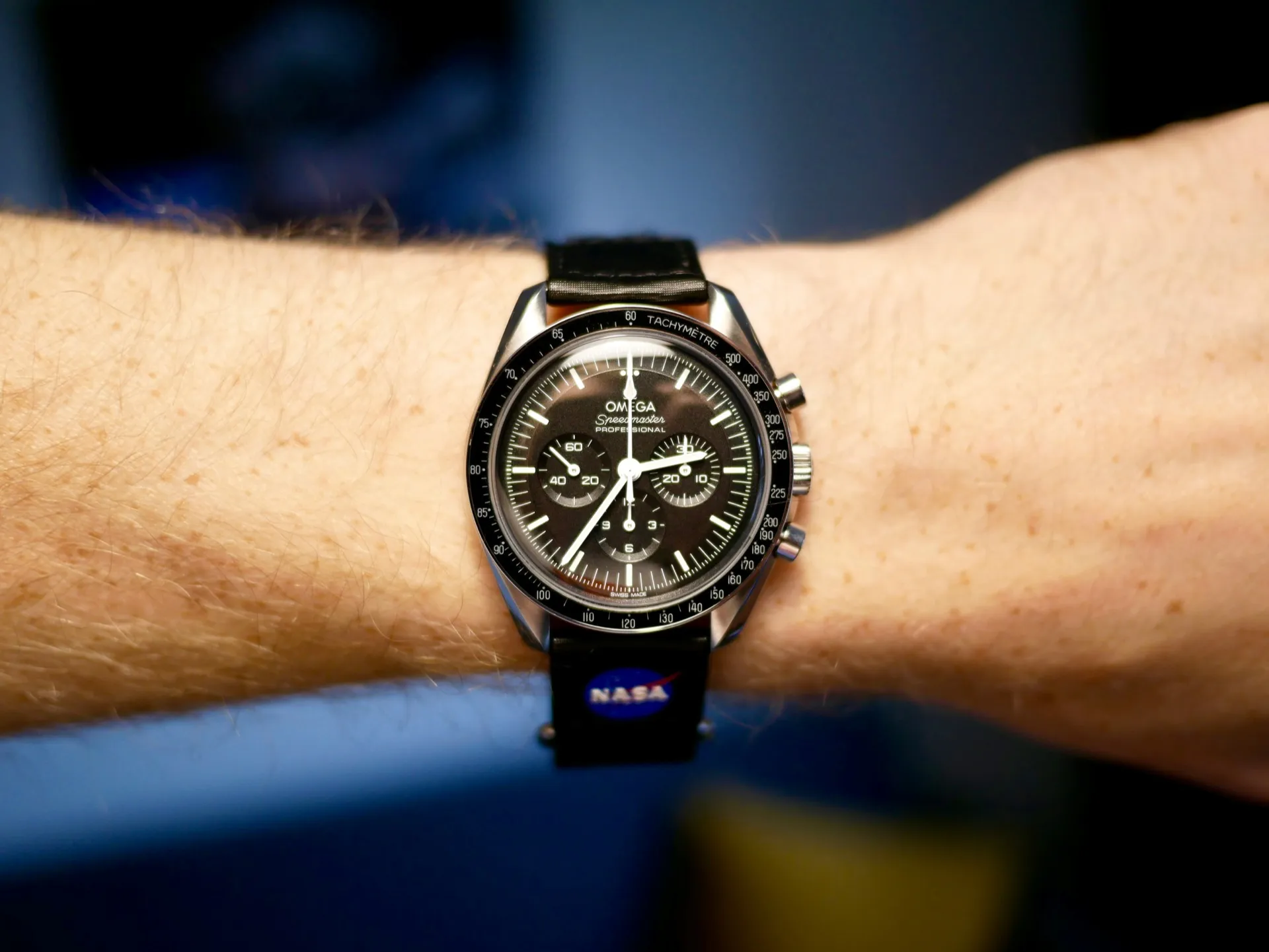
- Vintage caliber 321 models continue to appreciate — supply is finite and collector knowledge is increasing.
- The Snoopy premium persists — despite more units reaching the market, demand remains strong.
- Standard Moonwatch prices are stable — the Professional with caliber 1861 or 3861 trades in a predictable range with good liquidity.
- The MoonSwatch effect — Swatch's affordable MoonSwatch collaboration has increased brand awareness but has not significantly impacted genuine Speedmaster values.
Data from Chrono24 shows the Speedmaster Professional remains one of the most actively traded luxury watches globally, with consistent demand across all price tiers.
📖 Related: Where & How to Sell Watches — compare selling channels for your Speedmaster.
Final Thoughts
The Omega Speedmaster Professional offers something rare in the luxury watch world: genuine historical significance at an accessible price point. It's a watch that has been to the Moon, saved the crew of Apollo 13, and remained in continuous production for over 60 years. Whether you own a $4,000 vintage 145.022 or a $30,000 Silver Snoopy, you're wearing a piece of space history — and that story continues to drive collector interest generation after generation.
How to Value a Omega Speedmaster: Step by Step
-
Identify the Reference Number
Check the case back engravings or the inside of the case back (requires removal). Common formats: ST 145.022 (vintage), 311.30.42.30.01.005 (modern), 310.30.42.50.01.002 (current).
-
Determine the Caliber
The caliber determines value tiers. Caliber 321 (pre-1968) is most valuable. Caliber 861/1861 is the classic Professional movement. Caliber 3861 is the current Master Chronometer version.
-
Assess Dial and Hands
Check for original dial (correct printing, proper lume color for era). Vintage "stepped" dials and DON (Dot Over Ninety) bezels command premiums. Service replacement dials reduce value.
-
Examine the Bezel
The tachymeter bezel should match the era — aluminum insert on vintage, aluminum on classic, ceramic on some modern LE. The "Dot Over Ninety" bezel variant on vintage is highly collectible.
-
Check Case Condition
Asymmetric case (pre-1969 ref 105.003/105.012) vs symmetric case (145.022+) — different designs for different eras. Unpolished cases with sharp lugs are preferred.
-
Verify Bracelet Authenticity
Original bracelets (flat-link 1171, 1171/1, modern 1499/840) add significant value. The bracelet reference is stamped on the clasp or end links. Replacement bracelets reduce value.
-
Research Market Value
Check Chrono24 sold listings, Omega forums, and auction records. The Speedmaster market is well-documented with active collector communities that track specific references.
What Drives the Value
- Caliber — 321 (most valuable), 861/1861 (strong), 3861 (current), ETA-based Reduced (least valuable)
- Reference and era — pre-moon (CK2915/CK2998) commands highest premiums; Apollo-era 145.022 is the sweet spot of collectibility
- Dial originality — original dials with matching lume, correct fonts, and period-appropriate printing are essential for top values
- Limited edition status — Snoopy, First Omega in Space, Tintin, and CK2998 re-editions hold and appreciate well
- Case condition — unpolished cases are worth 20-30% more than polished examples on vintage references
- Completeness — original box, papers, moon-themed accessories on LE models significantly affect desirability
- NASA provenance — any documented connection to NASA missions or astronauts creates extraordinary premiums
Identification Checklist
- The Speedmaster Professional has a manual-wind movement — if it auto-winds when shaken, it's a Reduced, Automatic, or different model
- Pre-1969 models (CK2915, CK2998, 105.003) have an asymmetric case with crown guards integrated into the case design
- The iconic "Dot Over Ninety" (DON) bezel has the dot positioned above the 90 on the tachymeter scale — found on certain 1960s-70s bezels
- Hesalite (acrylic) crystal is standard on the Professional; sapphire crystal was offered as an option on some references
- The case back of the Moonwatch Professional features the Seahorse medallion (older) or "FLIGHT-QUALIFIED BY NASA" engraving (newer)
- Lume color helps date the watch: tritium (cream/yellow patina) pre-1998, luminova (white/green) 1998-2007, Super-LumiNova post-2007
- The stepped dial (raised hour marker ring) is found on early references and certain re-editions — highly collectible feature
How to Spot a Fake
- The Speedmaster Professional should NOT auto-wind — the movement is manual. An automatic winding rotor visible through a transparent case back is not a standard Professional
- Check the dial printing under magnification — Omega's "Ω" logo should be perfectly formed with no ink bleed or rough edges
- The crown should have the Omega logo engraved (not printed or stamped) with clean definition
- Pushers should have a distinctive crisp action — the chronograph should start, stop, and reset with precision
- Case back engravings should be sharp and properly spaced — the Seahorse medallion or "FLIGHT-QUALIFIED" text should be deeply and cleanly engraved
- For vintage models, have the movement inspected — genuine Omega calibers have specific finishing, Geneva stripes, and the Omega logo on the movement
- Check that the bracelet end links fit the case precisely — aftermarket bracelets often have slight gaps or misalignment at the lugs