This item is typically worth $5 – $75, depending on maker, condition, age and demand.
Market values current as of November 2026The Christmas boxes are coming down from the attic, and with them the yearly question: keep it, sell it or toss it? Most vintage ornaments, lights and figures are worth a few dollars each. A small share are worth real money, and they are easy to miss in a box of tangled garland.
A few minutes of checking before you hang anything, or bag it for the thrift store, tells you which is which.
Most vintage Christmas decorations sell for $2 to $30 each. Shiny Brite glass balls typically bring $2 to $10 apiece or $20 to $60 for a boxed set, and Hallmark Keepsake and Christopher Radko ornaments usually $3 to $50. The exceptions are mostly German and mostly pre-1940: heavy kugels, embossed Dresden paper ornaments, early figural glass, feather trees and composition Santas, which bring $100 to several thousand dollars. Christmas decorations photographed on Estimonia had a median estimate of $30.
Before you hang it or toss it: a five-minute check
- Old light sets: look before you plug in. The Consumer Product Safety Commission says to check every set, new or old, for broken or cracked sockets, frayed or bare wires and loose connections, and to throw out damaged sets. Brittle or cloth-covered cords belong on a shelf, not a tree; collectors buy boxed sets as display pieces anyway.
- Tinsel: heavy, drapey foil tinsel from before the early 1970s may contain lead; U.S. makers stopped producing lead tinsel in 1972 at the FDA's urging. Keep it away from children and pets.
- Glass ornaments: keep the caps and the boxes, even battered ones. Do not wash silvered or painted glass; water lifts paint and silvering.
- Paper and cotton pieces: embossed gold or silver cardboard animals and spun-cotton figures are fragile and can be the most valuable things in the box.
- Ceramic trees and figures: read the base for a maker's mark and date, and check for chips and missing bulbs.
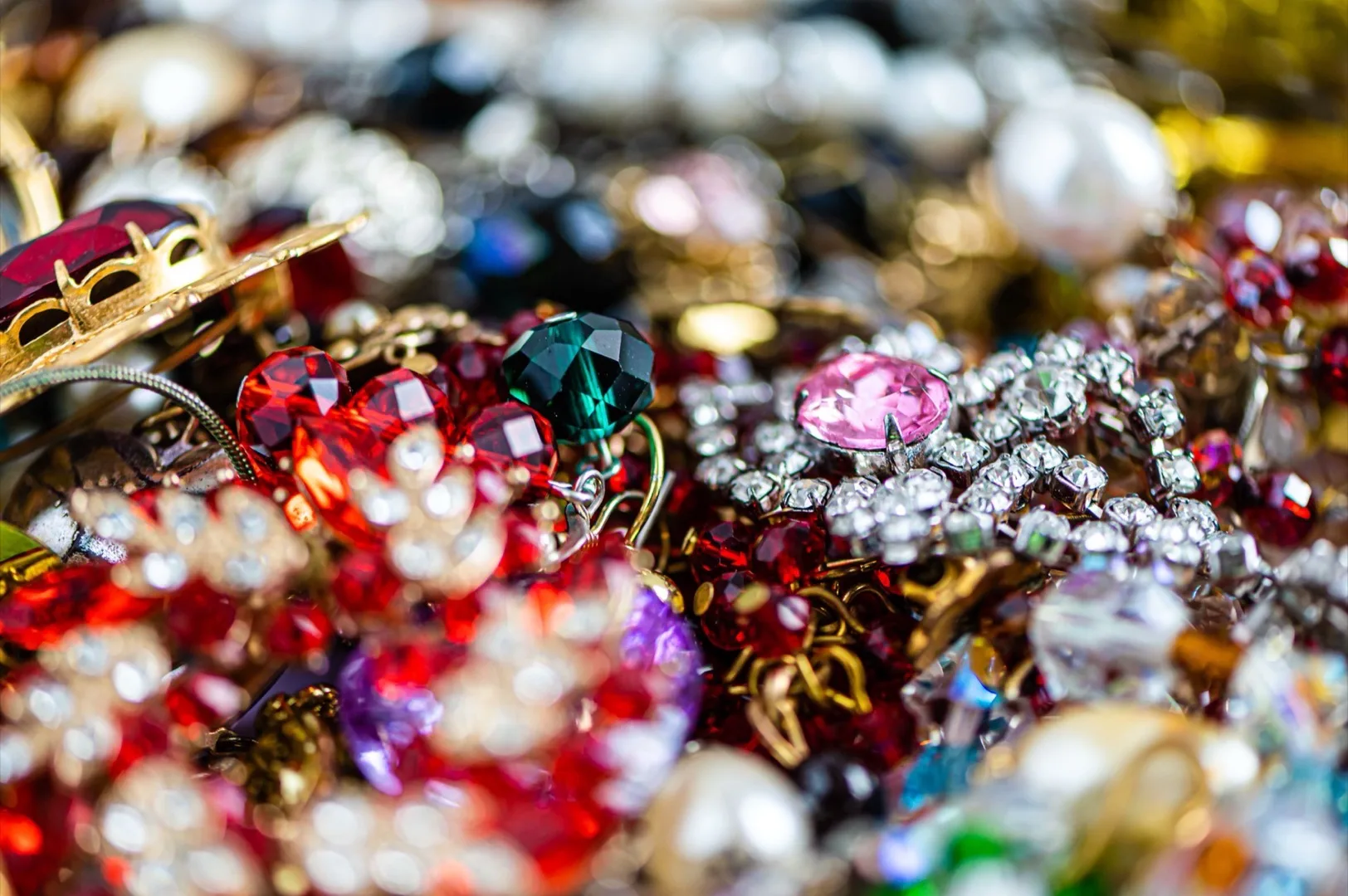
- Pins and brooches: check the back for a signature before they go in the donation bag.
For a first estimate, photograph the cap, the box and any label or base mark.
What do I have? Makers, marks and dates
Shiny Brite and other American glass
Max Eckardt, a German immigrant ornament importer, sold American-made ornaments as Shiny Brite. In 1939 he and Woolworth persuaded Corning to make ornament blanks on a ribbon machine built for light bulbs, as The Henry Ford museum explains. Dating clues:
- 1939 to 1941: silvered inside, metal caps.
- 1942 to 1945: metal went to the war effort, so caps became cardboard and string, and many balls were left unsilvered, clear with tinsel inside or with pastel stripes. War-era boxes often show Uncle Sam shaking hands with Santa.
- 1946 into the 1950s: silvering and metal caps returned; later caps are crimped and stamped "Shiny Brite" and "Made in U.S.A."
German glass, kugels and Dresden paper
Kugels are thick, heavy glass balls, grape clusters and other shapes made in Germany in the 1800s and early 1900s, with ornate brass caps. Pre-war German figural glass (Santas, birds, fruit, children) is thin and hand-blown. Dresden ornaments are embossed, gilded or silvered cardboard animals, boats and vehicles made in Germany around 1880 to 1910. Ornaments marked "West Germany" date from 1949 to 1990.
Hallmark Keepsake and Christopher Radko
Hallmark launched Keepsake Ornaments in 1973 with 18 designs: six glass balls and 12 yarn figures. It has since issued more than 10,000 year-dated designs, so supply is enormous; early and first-in-series pieces in their boxes sell best. Christopher Radko started his glass ornament line in 1986 and sold the company to Rauch Industries in 2005.
Ceramic trees, blow molds and lights
Atlantic Mold copyrighted its ceramic tree design in 1958 and made it until 1999, and the date in the mark may be the mold's date rather than the tree's. Many were poured and painted by hobbyists. Blow molds, the lit plastic Santas and snowmen, came mainly from Empire, General Foam and Union Products from the 1960s on, with the maker's name molded into the back or base. NOMA sold the first bubble lights in 1946.
Real or reproduction?
- New Shiny Brites: Christopher Radko revived the Shiny Brite name and has sold reproductions since 2001, as Antique Trader notes. New boxes carry the Radko name and modern barcodes.
- Kugel and Dresden copies: modern kugel-style balls are lighter, with plain or thin caps. New Dresden-style pieces are flat printed foil without crisp embossing.
- Ceramic trees: molds are still poured today. A modern switch, LED bulbs or a new cord point to a recent tree.
- Blow molds: General Foam took over Empire's molds and kept making the same designs into the 2000s, so a copyright date dates the design, not your piece.
- "Antique" mercury glass: very even, bright silvering, perfect paint and glued plastic caps point to a modern piece.
What vintage Christmas decorations sell for
Typical sold prices, not asking prices. Dealers usually pay a third to half of what they will charge.
| Item | Typical value | Notes |
|---|---|---|
| Shiny Brite or other 1940s to 1960s American glass ball | $2 to $10 each | Unusual shapes and wartime pieces at the top. |
| Boxed set of 12 Shiny Brites | $20 to $60 | All caps and a clean box. |
| Hallmark Keepsake ornament | $3 to $20 | Early and first-in-series pieces more. |
| Christopher Radko ornament | $15 to $50 | Retired limited pieces at the top. |
| Christmas tree brooch | $5 to $40 | Signed pieces more. |
| Blow mold Santa, snowman or candle | $20 to $80 | Rare figures and complete sets far more. |
| Ceramic Christmas tree | $40 to $150 | Large or musical trees higher. |
| Pre-war German figural glass ornament | $15 to $100 each | Rare figures reach the thousands. |
| German kugel | $50 to $300 each | Grapes and large sizes higher. |
| Dresden paper ornament | $100 to $500 each | Rare subjects reach the thousands. |
| German composition Santa or candy container | $300 to $3,000+ | Size and original paint drive price. |
Wondering about yours?
Find out what your item is worth
Upload a photo and get an instant AI valuation with a realistic price range — free, and no account needed.
Recent auction results, including buyer's premium:
- $162.50: ten mid-century Japanese and European glass ornaments and garlands, with chips and losses, Jeffrey S. Evans, August 2025 (verified).
- $307.50: 15 German and American figural glass ornaments, including a Doubl-Glo Snow White and the Seven Dwarfs set of about 1938, Jeffrey S. Evans, September 2024 (verified).
- $687.50: six German Dresden and kugel ornaments, late 1800s to early 1900s, estimate $150 to $250, Jeffrey S. Evans, September 2024 (verified).
- $127: an unmarked 23-inch ceramic tree with a music box and bird and holly bulbs, Keystone Auctions, reported in the Kovels' column, December 2025 (verified).
- $1,464: five large Dresden reindeer ornaments, Pook & Pook, December 2020 (verified).
- $3,416: a fully decorated feather tree, the best of several in the sale, Pook & Pook, December 2020 (verified).
- $5,100: an early 1900s yellow glass figural ornament of a child, 5 inches, Bertoia, January 2026 (verified).
- $9,600: a 5-inch Dresden ornament of a woman in a sleigh, high estimate $3,000, Bertoia Auctions, January 2026 (verified).
The ordinary lots are the guide for most boxes; the four-figure results are fine German pre-war pieces in specialist sales.
What Estimonia valuations show
From July to early November 2026, people photographed 103 Christmas decorations on Estimonia. Half were estimated at $30 or less, and 41 percent came in under $25. One in four was estimated above $58 and one in ten above $225. Seventeen percent reached $100 or more, 7 percent $500 or more, and four pieces $1,000 or more.
The mix looked like real holiday boxes: boxed General Electric light sets, glass ornament sets in their original boxes, hand-painted Christmas tree pins, German porcelain pieces, decorated egg ornaments, a boxed Portmeirion teacup ornament, Christmas books and records, and Nightmare Before Christmas items.
These are AI estimates from photos people uploaded, not sale prices, which is why they show what is typical in real homes rather than auction headlines. For your box, expect most single pieces to be worth tens of dollars, not hundreds. The pieces worth photographing one by one are old German glass, paper and composition, boxed early light sets and signed jewelry.
What to do now
- Do not clean or repair first. Washing, re-gluing caps, rewiring lights or repainting blow molds lowers value.
- Keep sets together in their boxes.
- Sell common pieces online or locally. eBay charges most sellers 13.6% of the total sale plus $0.40 on orders over $10, according to its fee page. Glass ships badly, so many owners sell locally; our comparison of estate sales, auctions and selling it yourself shows the trade-offs.
- Consign the good German pieces. Kugels, Dresden, pre-war figurals and composition Santas sell best in holiday sales at houses such as Bertoia, Pook & Pook and Jeffrey S. Evans; see our guide to auction house fees.
- Donate the rest. Thrift stores sell ordinary decorations quickly in December.
Santa candy containers and tin toys from under the tree belong in our vintage toy value guide, porcelain Christmas figures and cottages in the porcelain figurine value guide, and tree pins in the vintage costume jewelry value guide. Clearing a whole house? Start with 15 everyday items that could be worth serious money.
Trusted resources
- The Golden Glow of Christmas Past: the largest collector club for antique and vintage Christmas, with a magazine, articles and an annual convention.
- The Henry Ford and Hallmark's corporate history pages: Shiny Brite and Keepsake Ornament history.
- Past results at Bertoia, Pook & Pook and Jeffrey S. Evans: real prices for German glass, Dresden and Santas.
What Drives the Value
- Age and origin — pre-1940 German glass, kugels and Dresden paper are worth many times postwar American glass.
- Original box — a clean, complete box adds real value to a set of ordinary glass balls.
- Condition — paint loss, flaking silvering, cracks and replaced caps cut value sharply.
- Form — figurals such as Santas, animals, children and vehicles beat plain balls.
- Size and color — large kugels and uncommon colors bring the highest prices.
- Completeness — ceramic trees with all their bulbs and blow mold sets with every figure sell for much more.
- Production volume — Hallmark and Radko made huge numbers, which keeps most prices low.
- Venue — specialist holiday auctions reach collectors of German pieces; thrift and online sales set prices for common glass.
Identification Checklist
- Read the cap: crimped metal caps stamped "Shiny Brite" and "Made in U.S.A." are postwar; cardboard caps with string point to 1942 to 1945.
- Look inside clear balls: unsilvered glass, sometimes with tinsel inside, is typical of wartime Shiny Brite production.
- Weigh it in your hand: kugels are thick, heavy glass with ornate brass caps, made in Germany in the 1800s and early 1900s.
- Embossed, gilded or silvered cardboard animals and vehicles are Dresden ornaments, made in Germany around 1880 to 1910.
- Find the year: Hallmark Keepsake ornaments are year-dated and came in dated boxes from 1973 on.
- Turn ceramic trees over: Atlantic Mold trees are usually marked, but the date can be the mold date, not the tree date.
- Check the back or base of blow molds for a molded maker name such as Empire, General Foam or Union Products.
- Read country marks: "West Germany" dates a piece to 1949 to 1990, and "Czechoslovakia" to 1918 to 1992.
How to Spot a Fake
- Christopher Radko has sold Shiny Brite reproductions since 2001; check the box for the Radko name and modern barcodes.
- Very even, bright silvering and perfect paint on "antique" mercury glass usually mean a modern piece.
- Modern kugel-style balls are lighter than real kugels and have plain or thin caps.
- True Dresden embossing is crisp and three-dimensional; flat printed foil on thin board is modern.
- A mold date on a ceramic tree or blow mold is the design date, not proof of the piece's age.
- Have rare-looking German pieces checked by a holiday specialist auction house before selling.