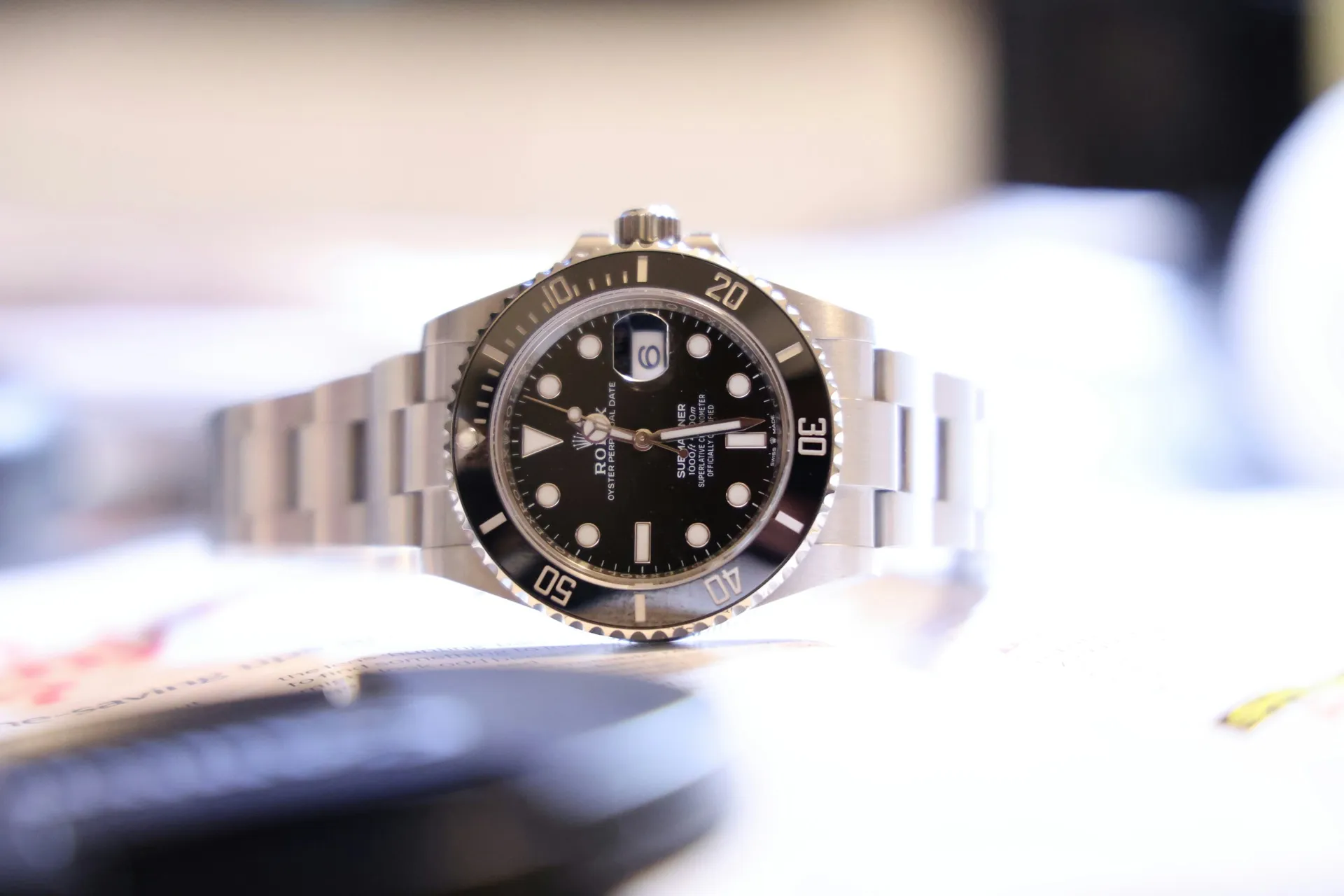
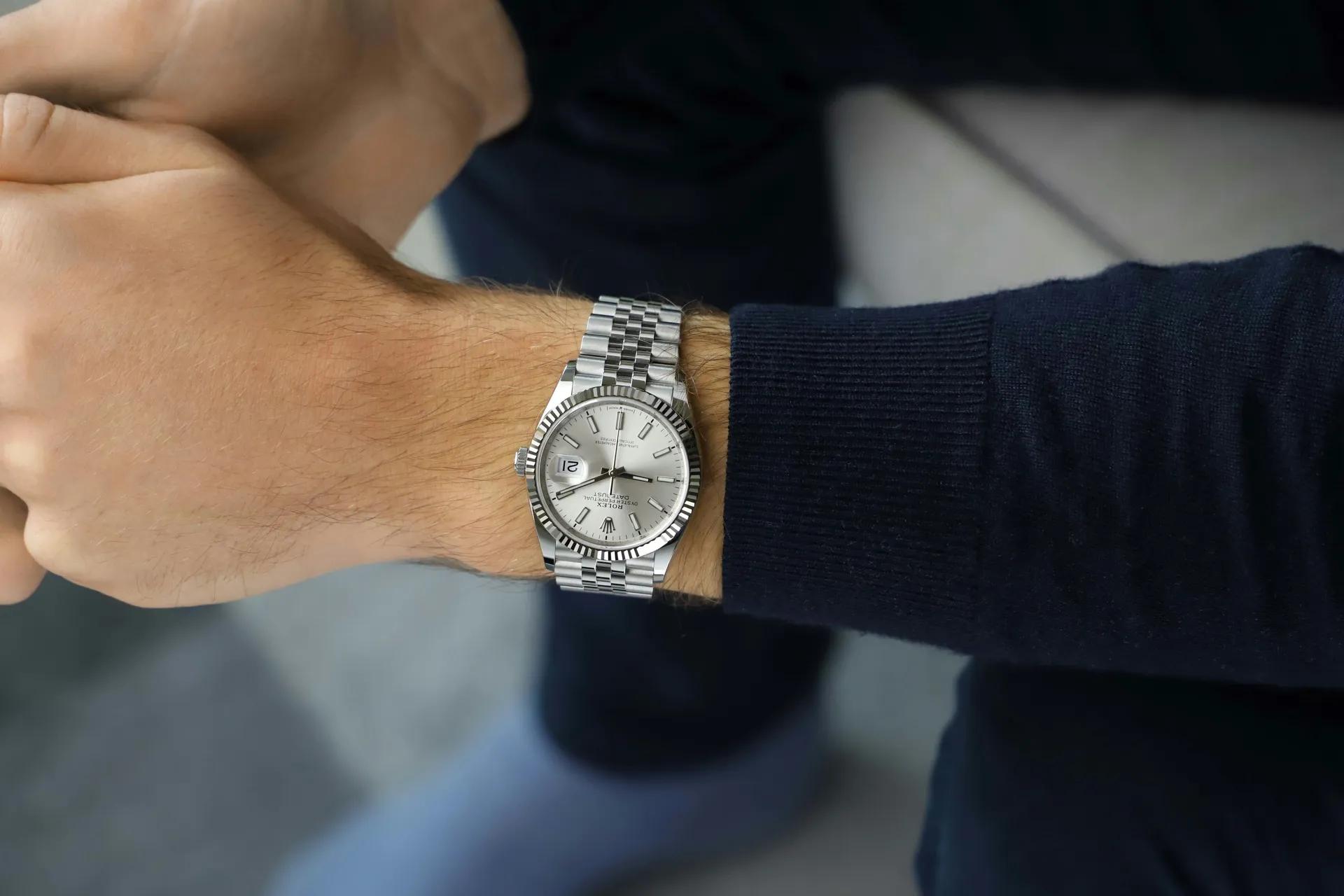
A Rolex is typically worth $2,000 – $22,000, depending on reference, condition, originality, and provenance.
Market values current as of October 2026Rolex has never published an official serial number register, but collectors have pieced together charts from thousands of dated watches and papers. With the serial number you can usually date a Rolex to within a year or two. The reference number tells you the model, bezel and metal.
Age alone does not make a Rolex valuable. A 1970s steel Oyster Perpetual is often worth less than a 2000s Submariner. What matters is the model, how original the watch is, and whether the papers survive.
Serials below 1,000,000 date to before 1964 (numbering restarted around 1954), 2,000,000 is about 1969, 5,000,000 about 1977 and 9,400,000 about 1987. From 1987 a letter prefix replaced the leading digit: R (1987), L (1989), E (1990), X and N (1991), C (1992), S (1993), W (1995), T (1996), U (1997), A (1999), P and K (2000), Y (2002), F (2003 to 2005), D, Z, M, V and finally G (2010). Since about 2010 serials are random and cannot be dated without papers.
Where to find the serial and reference number
Take the bracelet off, or ask a jeweler to. The serial is engraved between the lugs at 6 o'clock and the reference between the lugs at 12 o'clock. From the mid-2000s Rolex also engraved the serial on the rehaut, the inner ring around the dial at 6 o'clock, and from about 2008 it appears only there. Some vintage watches also have a quarter-and-year stamp inside the caseback, such as "I.72" for the first quarter of 1972, but only a watchmaker should open the case. Punched papers or a warranty card show the sale date and should match the case serial.
Rolex serial numbers by year
| Serial starts around | Year | Notes |
|---|---|---|
| 709,000 to 856,000 | 1951 to 1953 | Numbering then restarted near zero. |
| 23,000 to 399,000 | 1954 to 1959 | Six digits after the restart; check reference and style. |
| 516,000 / 824,000 | 1960 / 1963 | Early Submariner 5512, Day-Date 1803. |
| 1,008,000 / 1,538,000 | 1964 / 1967 | Gilt dials give way to matte dials on sports models. |
| 2,241,000 / 2,890,000 | 1970 / 1972 | Datejust 1601, Oyster Perpetual 1002, Submariner 5513. |
| 4,115,000 / 5,737,000 | 1976 / 1979 | Quickset Datejust 16013 and Day-Date 18038 arrive. |
| 6,434,000 / 8,070,000 | 1980 / 1984 | Sapphire crystals become standard. |
| 8,900,000 / 9,400,000 | 1986 / 1987 | Numbers reach the end of the seven-digit run. |
| R, L, E | 1987 to 1990 | R was used from 1987 into 1988, L in 1989, E in 1990. |
| X, N, C, S | 1991 to 1994 | X was used only briefly in 1991. |
| W, T, U, A | 1995 to 1999 | Tritium "T SWISS T" dials end around 1998. |
| P, K, Y | 2000 to 2002 | Laser-etched crystal crown appears around 2002. |
| F, D, Z, M, V, G | 2003 to 2010 | Letters overlap by a year; rehaut serial engraving begins. |
| Random (e.g. 8 mixed characters) | 2010 onward | Date by warranty card only. |
Wondering about yours?
Find out what your Rolex is worth
Upload a photo and get an instant AI valuation with a realistic price range — free, and no account needed.
Figures follow the widely used Bob's Watches serial chart. Treat them as approximate: cases were made before the watch was sold, so papers may be dated a year or more after the serial suggests.
How to read a Rolex reference number
On five-digit references (about 1977 to 2005), the first three digits are the model, the fourth the bezel and the fifth the metal. In 16233, 162 is the Datejust, 3 is the fluted bezel and 3 is steel with 18k yellow gold. Common metal codes: 0 steel, 3 steel and yellow gold, 4 steel and white gold, 8 yellow gold, 9 white gold. Bezel codes: 0 smooth, 1 engine-turned, 3 fluted. Six-digit references from about 2000 work the same way with one more digit at the front (126233). Four-digit references such as 1601, 1803 and 5513 are older and must simply be looked up.
How age changes the value
- Pre-1990 tritium dials: Dials marked "T SWISS T" or "SWISS T < 25" use tritium lume that ages to cream or brown. Collectors pay more for an even, untouched patina, and less once a service dial has replaced it.
- Papers and box: Original punched papers can add 10 to 20 percent on 1970s and 1980s watches, sometimes more on sports models.
- Service history: Regular service is good, but a service that replaced the dial, hands and bezel removes much of a vintage watch's premium. Keep any old parts.
- Polishing: Sharp case edges and a crisp caseback are worth more than a shiny, rounded case.
| Item | Typical value | Notes |
|---|---|---|
| 1950s to 1970s steel Oyster Perpetual or Air-King | $2,000 to $5,000 | Original dial and box add most. |
| 1960s to 1980s Submariner 5513 | $10,000 to $18,000 | Gilt and early matte dials bring the most. |
| 1960s to 1980s Day-Date 1803 or 18038 | $11,000 to $22,000 | Rare colored dials can bring well over $30,000. |
| 1977 to 2005 Datejust 16013 or 16233 | $4,500 to $8,000 | Papers and an original dial add 10 to 20 percent. |
| 1988 to 2010 Submariner 16610 | $8,000 to $11,000 | Later rehaut-engraved examples bring a little more. |
| 2010 onward models | 60 to 90 percent of current retail | Steel sports models hold value best. |
Dated Rolex sales at auction
- £10,062: Submariner ref. 5513, circa 1967, serial 158xxxx. Bonhams London, December 2019 (verified).
- £11,475: Submariner ref. 5513, circa 1968, serial 1823101. Bonhams London, September 2022 (verified).
- £1,792: Oyster Perpetual ref. 1002, circa 1968, serial 1857920. Bonhams online, April 2025 (verified).
- €33,750: Day-Date ref. 1803 from 1972 with a blue "Buckley" dial. Monaco Legend Auctions, April 2024 (verified).
- HK$44,625: Datejust ref. 16233, circa 1991, with punched certificate. Bonhams Hong Kong, June 2022 (verified).
- £5,250: Submariner Date ref. 16610, circa 1999, with box. Bonhams London, February 2019 (verified).
The serials in these lots line up with the chart above, which is a good first sanity check on any watch.
What to do with your Rolex now
- Write down the reference and serial, then photograph the dial, caseback and the numbers between the lugs for an AI estimate.
- Do not polish it or have it serviced before selling. A buyer will want to see the original dial and hands.
- Check that it is genuine: see this checklist of fake Rolex signs and our watch valuation page.
- Compare offers. Jewelers typically pay 55 to 70 percent of retail, specialist dealers 70 to 85 percent, and auction sellers usually net 85 to 90 percent of the hammer after commission. Find dealers and auction houses in our watch directory.
For model detail, see the Rolex Datejust value guide and the Rolex Submariner value guide.
Trusted resources
- Bob's Watches: Rolex serial numbers by year: the year chart and clasp codes.
- Bonhams, Phillips and Christie's online catalogs: search your reference for dated, sold examples.
What Drives the Value
- Model — a 1960s Submariner 5513 typically brings $10,000 to $18,000, while a steel Oyster Perpetual 1002 from the same years brings $2,000 to $5,000.
- Original dial — an untouched tritium dial with even patina is worth more than a service replacement.
- Papers — punched certificates matching the case serial add 10 to 20 percent.
- Metal — 18k gold Day-Dates have a gold-weight floor that steel models lack.
- Case condition — unpolished lugs and a crisp caseback add value on vintage pieces.
- Rare variants — gilt dials, colored Day-Date dials and early references can multiply value.
- Sales route — jewelers typically pay 55 to 70 percent of retail; auctions and specialist dealers pay more.
Identification Checklist
- The serial is engraved between the lugs at 6 o'clock; the reference between the lugs at 12 o'clock.
- From the mid-2000s the serial also appears on the rehaut at 6 o'clock, and from about 2008 only there.
- Seven-digit serials around 1,000,000 date to 1964, 2,000,000 to about 1969 and 9,400,000 to 1987.
- Letter-prefix serials run R (1987), L, E, X, N, C, S, W, T, U, A, P, K, Y, F, D, Z, M, V to G (2010).
- Some vintage casebacks carry a quarter and year stamp inside, such as I.72 for early 1972.
- On five-digit references the last digit is the metal: 0 steel, 3 steel and yellow gold, 8 yellow gold.
- Dials marked T SWISS T use tritium and date to before about 1998.
How to Spot a Fake
- The serial must match the age of the reference; a 5513 with a 2000s letter serial is wrong.
- Numbers between the lugs should be deep and sharply engraved, never dotted or acid-etched.
- Counterfeiters reuse the same serial on many watches, so search the number online.
- Papers should list the same serial as the case; mismatched papers are common on swapped watches.
- Random-serial watches from 2010 onward should have the serial on the rehaut, not between the lugs.
- Ask a watchmaker to confirm the movement caliber matches the reference and period.
Thinking of Selling?
The route often matters as much as the item. A dealer typically pays 45–70% of an item's value, so they can resell it at a profit; an auction house typically returns 75–88% after its commission, but takes weeks.
-
See where yours sits
Photograph it and get a value range in about 20 seconds — free, no account needed.
-
Meet the right specialists
If it's worth $1,000 or more, we can introduce you to auction houses that handle pieces like it. Free for you, and you decide whether to go ahead.
-
Or get a step-by-step plan
A Sell-it Plan ($9.99) compares auction, dealer and online sale for your item, shows what you would keep after fees, names auction houses that take pieces like it, and drafts your enquiry email.