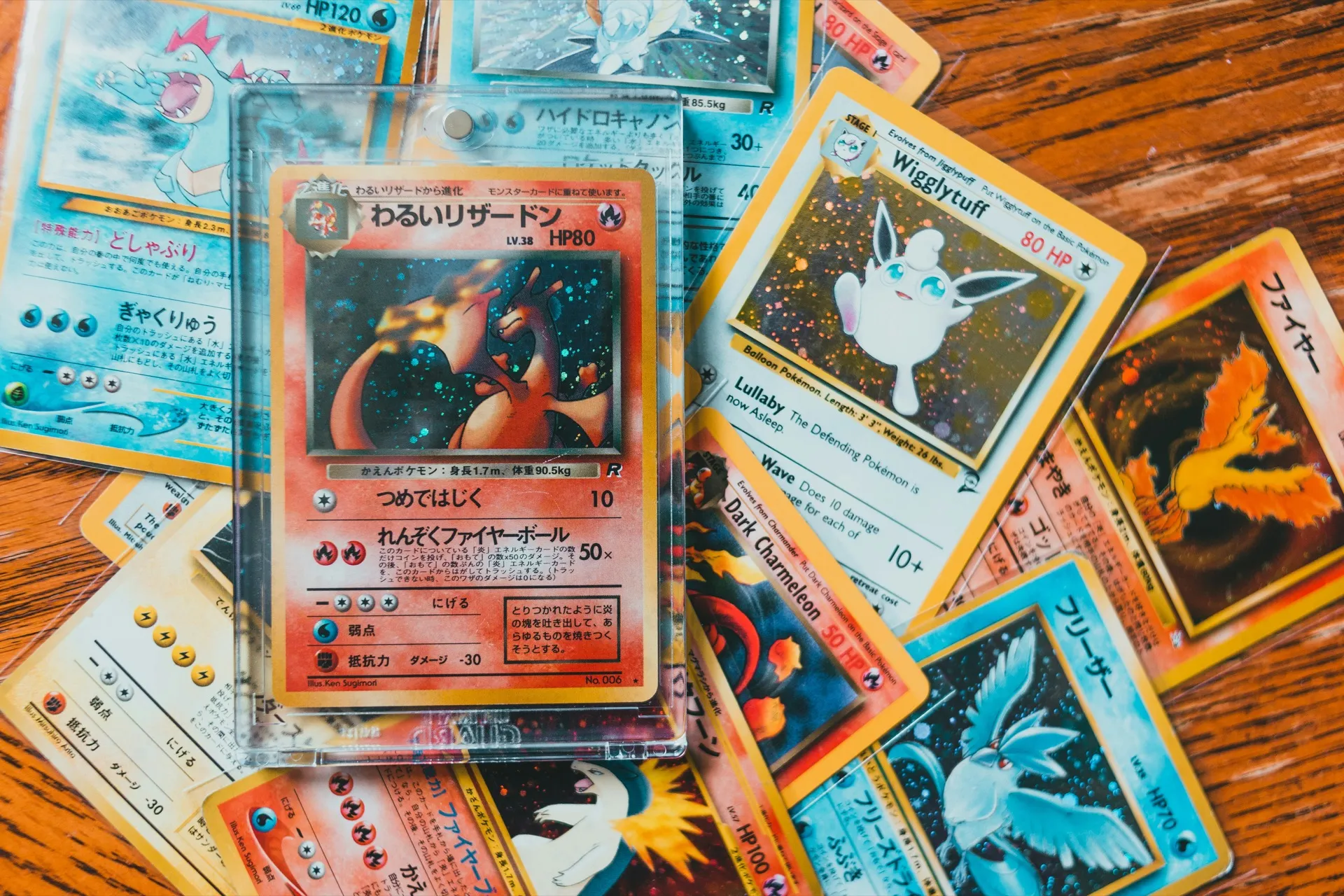
A Pokémon card is typically worth $0.05 – $1,000, depending on reference, condition, originality, and provenance.
Market values current as of October 2026Thinking of grading it? Work out whether it pays →
If you found a shoebox or a binder of your kids' Pokémon cards from around 1999, you have probably heard the stories about cards selling for six figures. Those stories are real, but they are about a handful of perfect, graded cards. A box of played cards from the attic is a different thing. This guide tells you what a normal collection actually sells for, which cards to check first, and how to sell without leaving money on the table.
The honest answer first
Pokémon printed huge numbers of cards in 1999 and 2000. Most kids had hundreds of them, and most of those cards were played with, traded, and stored loose. That means common cards from that era are not rare.
- Commons and uncommons (black or diamond rarity symbol, no shiny art): usually 1 to 5 cents each if worn, maybe 15 to 25 cents if they look pack-fresh.
- Energy cards: worth almost nothing.
- Non-holo rares (star symbol, flat art): often 50 cents to a few dollars each.
- Holo rares (star symbol, shiny art box): a few dollars up to hundreds, depending on the Pokémon and condition.
So a binder of 300 cards is often worth $20 to $100 in total, unless a few specific cards are inside. The next section shows you how to find them.
The 5-minute sort
You do not need to know anything about Pokémon to do this. Lay the cards out and make these piles.
- Sealed product. Unopened booster packs, theme decks, or boxes go in their own pile and stay unopened. A sealed Base Set Unlimited booster pack typically sells for around $600, and a 1st Edition pack for several thousand (PriceCharting averages, fall 2026). Sealed product is often worth more than every loose card in the box.
- Shiny art. If the picture inside the frame is foil and sparkles, that is a holo. Pull every one.
- 1st Edition stamp. Look just below the bottom-left corner of the picture. A small black circle with "Edition 1" means a first print run. These are worth much more. See our 1st Edition vs Shadowless vs Unlimited guide to tell them apart.
- Old vs new. Cards from the Wizards of the Coast era (1999–2003) carry copyright years in the late 1990s to early 2000s along the bottom, and most include a Wizards credit. Newer cards from 2004 on credit Nintendo, Creatures, and GAME FREAK only. Old cards sell better, but newer full-art and "ex" cards can also be worth a few dollars each.
- Japanese cards. Different back design and Japanese text. Set these aside and check our Japanese Pokémon card value guide.
- Promos. Cards with a black star "PROMO" symbol, often from movie theaters, toys, or magazines. Most are worth a few dollars. A few are worth more.
Everything left over is bulk. That is usually 90% or more of the box.
What bulk and binders actually sell for
Bulk prices are low and steady. These are typical cash buylist prices from game stores, not what sellers are asking online.
| What you have | Typical sold or buylist price | Notes |
|---|---|---|
| Sorted commons and uncommons | $10–$30 per 1,000 | Game store cash price; store credit runs a bit higher |
| Unsorted bulk | $5–$10 per 1,000 | Some stores pay a flat rate for unsorted boxes |
| Holo and reverse holo bulk (modern) | $10–$60 per 1,000 | Common holos only, not the Base Set stars |
| WOTC-era (1999–2003) commons, played | 1–5 cents each | Vintage helps a little, condition helps more |
| WOTC-era commons, near mint | 15–25 cents each | Clean lots of 100+ on eBay can reach 30–40 cents a card |
| Modern ultra rares (EX, GX, V) | 30–75 cents each | Game store buylist |
Wondering about yours?
Find out what your Pokémon card is worth
Upload a photo and get an instant AI valuation with a realistic price range — free, and no account needed.
Sources: Monster and Shield bulk price survey (September 2026), game store buylists, and eBay sold listings for WOTC lots.
The cards worth checking first
The Base Set (1999) is the one most people find. Its 16 holo rares are numbered 1 through 16 out of 102 in the bottom-right corner. These are the cards to look up first. The ranges below are typical sold prices for raw (ungraded) cards, based on PriceCharting averages and eBay sold listings as of fall 2026.
| Base Set holo | Unlimited, played | Unlimited, clean / near mint | 1st Edition, raw |
|---|---|---|---|
| Charizard (4/102) | $250–$350 | $400–$600+ | Often $5,000–$10,000+ |
| Blastoise (2/102) | $50–$90 | $100–$200 | Around $1,000–$1,500 |
| Venusaur (15/102) | $40–$75 | $80–$150 | Around $800–$1,200 |
| Mewtwo, Raichu (10, 14) | $15–$25 | $30–$60 | Mewtwo around $400–$600 |
| Alakazam, Gyarados, Zapdos, Ninetales, Chansey, Clefairy | $10–$20 | $25–$50 | Hundreds, depending on the card |
"Shadowless" Base Set cards, which have no drop shadow on the right edge of the art box, sit between Unlimited and 1st Edition. A shadowless Charizard has recently averaged close to $1,000 raw on PriceCharting, with damaged copies selling far lower. Our identification guide explains how to spot one.
Holos from the sets that followed (Jungle, Fossil, Team Rocket, Gym Heroes, Gym Challenge, the Neo sets) usually sell for $5 to $50 raw. A few, like Neo Genesis Lugia, Neo Destiny shining Pokémon, and the Gym "Blaine's" and "Sabrina's" holos, can go higher. For a set-by-set breakdown, see our vintage Pokémon card value guide.
About the record prices you read about: a PSA 10 1st Edition Charizard sold at Heritage Auctions for $550,000 in December 2025 (TheGamer), and in February 2026 Goldin sold one pulled on camera by Logan Paul for $954,800 (Sports Illustrated Collectibles). Those are perfect-grade 1st Edition cards. An Unlimited Charizard from a kid's binder is worth hundreds, not hundreds of thousands.
Condition changes everything
Two copies of the same card can differ in price by five times or more. Buyers check four things.
- Whitening on the back edges. The blue border on the back shows white chips where it was handled or shuffled. Some whitening is normal. Heavy whitening drops the card to "played."
- Creases and bends. Any crease is a big hit. A creased holo often sells for a quarter or less of a clean one.
- Scratches on the holo. Tilt the card under a lamp. Scratches across the foil art are common on vintage holos and lower the price.
- Centering. The yellow border should be roughly even on all sides. Off-center cards sell for less, especially if you ever plan to grade.
Do not try to clean, flatten, or press cards. It rarely helps and can make things worse. Put good cards in a penny sleeve and a hard plastic top loader right away.
Grading by PSA, CGC, or Beckett can multiply the value of a clean Charizard or 1st Edition card, but it costs money and takes time. For most played cards it does not pay. Our grading guide and the card grading calculator help you decide card by card.
Watch out for fakes
Fake Pokémon cards are common, especially Charizards. Warning signs:
- The back is the wrong shade of blue, looks washed out, or the swirl looks blurry.
- The card feels thin, glossy, or too flexible. Real cards have a dark layer inside you can see from the edge.
- Spelling mistakes, odd fonts, or HP numbers and attacks that do not match the real card.
- A "holo" that is shiny all over the card, including the text, instead of just the art box.
Compare a suspect card side by side with a common you know is real from the same box. Most fakes stand out right away.
How to sell
Match the selling method to what the card is worth.
- Bulk (the 90%): Take it to a local game store or mail it to an online bulk buyer. It is fast and the price is fair for what it is. Listing bulk one card at a time is not worth your time.
- Cards worth $5 to $500: eBay works well. Search your card, then filter to "Sold items" to see what people actually paid. TCGplayer market price and PriceCharting are good cross-checks. Take clear photos of the front and back.
- Cards or sealed product worth $500 and up: Consider a marketplace or auction house that specializes in cards, like Fanatics Collect (formerly PWCC), Heritage Auctions, or Goldin. They charge fees, but they reach serious buyers and handle trust for high-dollar items.
Avoid selling the whole box to the first person who makes an offer before you have pulled the holos, 1st Editions, and sealed packs. That is where most people lose money.
Not sure what you have? Use our free photo valuation. Photograph the front and the back of each card you are unsure about, plus a close-up of the bottom-left corner of the art box (where the 1st Edition stamp sits) and the bottom-right corner (set symbol and card number). For other card types, see our trading card value guide.
How to Value a Pokémon card: Step by Step
-
Pull out sealed product
Set aside any unopened packs, boxes, or theme decks and do not open them. Sealed vintage product is often worth more than the loose cards.
-
Sort the holos and stamps
Pull every card with shiny art, every card with a 1st Edition stamp under the bottom-left of the art, and any Japanese cards or promos.
-
Check sold prices for the keepers
Look up each pulled card on eBay sold listings, PriceCharting, or TCGplayer market price. Compare cards in similar condition, not asking prices.
-
Protect the valuable cards
Put any card worth more than a few dollars in a soft sleeve and a hard top loader. Do not clean, flatten, or press them.
-
Sell bulk and singles separately
Sell the bulk to a game store or bulk buyer. List mid-value cards on eBay or TCGplayer, and send cards or sealed product worth $500+ to a card auction house.
-
Get a free photo valuation if unsure
Photograph the front and back, plus the bottom-left corner of the art box and the bottom-right set symbol, and upload them to the free scan tool.
What Drives the Value
- Rarity — commons and uncommons sell for cents, while holo rares can sell for dollars to hundreds of dollars.
- Edition — 1st Edition cards sell for many times more than Unlimited prints of the same card, with Shadowless in between.
- Which Pokémon — Charizard leads by a wide margin, followed by Blastoise and Venusaur; most other holos sell for $10 to $50 raw.
- Condition — whitening, creases, and holo scratches can cut a card's price by half or more.
- Sealed status — unopened booster packs and boxes often sell for more than the cards inside them.
- Era — Wizards of the Coast cards (1999–2003) carry a premium over most later commons.
- Grading — a high PSA, CGC, or Beckett grade can multiply value on top cards, but rarely pays for played or common cards.
Identification Checklist
- Check the copyright line along the bottom. Years from 1995 to 2003, usually with a Wizards credit, mark the vintage era.
- Look for shiny foil inside the picture frame. That marks a holo rare, the first cards to price.
- Look just below the bottom-left corner of the art box for a small black "Edition 1" stamp. It means 1st Edition and a much higher value.
- Read the card number in the bottom-right corner. Base Set holos are numbered 1 through 16 out of 102.
- A black star rarity symbol means rare, a diamond means uncommon, and a circle means common.
- Base Set cards with no drop shadow on the right side of the art box are "shadowless," an earlier and more valuable print.
- A different card back with Japanese text means a Japanese card, which is priced separately.
- Keep unopened packs, boxes, and theme decks sealed and separate. They are often the most valuable items in the collection.
How to Spot a Fake
- Compare the back with a common from the same box. Fakes often have the wrong blue, a faded look, or a blurry swirl.
- Real cards have a dark inner layer visible from the edge. Fakes often look solid white and feel thin or glossy.
- Check spelling, fonts, HP, and attack text against a trusted image of the real card.
- On a real holo, only the art box is foil. A card that is shiny all over is a red flag.
- Be careful with 1st Edition and Charizard cards in particular. They are the most faked, so verify before you price or sell.