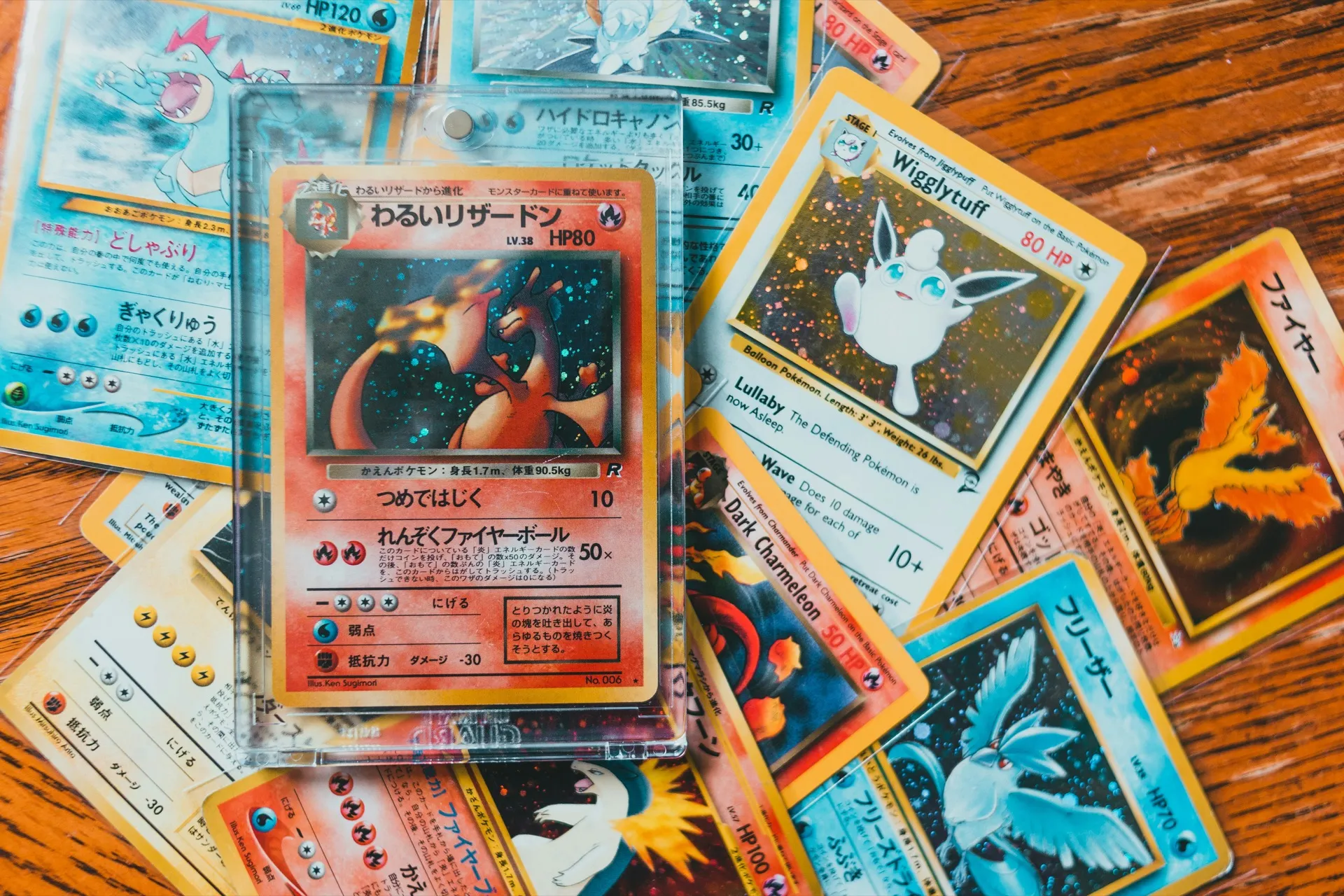
A Japanese Pokémon card is typically worth $1 – $350, depending on reference, condition, originality, and provenance.
Market values current as of October 2026Thinking of grading it? Work out whether it pays →
Japanese Pokémon cards turn up in the same places English ones do: shoeboxes, binders, and the belongings of someone who traveled to Japan or served overseas. They look different, so many owners assume they are either worthless or very rare. Usually the truth is in between. This guide explains how to tell what you have and what it typically sells for.
If you are not sure your cards are Japanese, or you have a mixed pile, start with our overview: Are old Pokémon cards worth anything?
Are Japanese cards worth more or less than English?
For most vintage cards, less. English Base Set cards from 1999 are the cards most American collectors grew up with, so demand is higher. A raw Japanese Base Set Charizard averages around $320 on PriceCharting. A raw English Base Set Charizard sells for several times that.
Japanese cards also tend to be printed with better centering and cleaner surfaces. That means more of them earn high grades, so a PSA 10 is less scarce than it is for the English version.
There are important exceptions. Some cards were only released in Japan, or only in tiny numbers. These are the cards that set records:
- 1996 "no rarity symbol" Base Set. The first Japanese print run, released in October 1996, had no circle, diamond, or star in the corner. It is the closest thing Japan has to a first edition.
- Trophy and tournament promos. Cards like the Trophy Pikachu were given only to top finishers at official Japanese events in the late 1990s.
- Magazine and contest promos. The Pikachu Illustrator was awarded to winners of a 1998 CoroCoro Comic art contest. Other CoroCoro and magazine promos are far cheaper but still collected.
- Pocket Monsters Vending series. Glossy cards sold in sheets of three from vending machines in Japan starting in 1998. They have no English version.
- Modern Japanese-only sets and Special Art Rares. Some recent Japanese sets, like Eevee Heroes and VMAX Climax, have no exact English match, which supports demand.
How to tell if you have a vintage Japanese card
Check the back
Japan changed its card back in July 2001. The old back (1996 to 2001) says "POCKET MONSTERS" across the top, with "CARD GAME" on a ribbon under the Poké Ball. It is dark navy with cream-colored rays and a thin red line near the edge, plus copyright lines at the bottom. The current back shows the Pokémon logo and a thick gold border. It looks very close to the English back.
An old back means your card is from the vintage era. A new back means 2001 or later.
Look for the rarity symbol, not a 1st Edition stamp
Japanese cards printed before 2001 do not have a 1st Edition stamp. If you see one on an old-back card, be careful. For the 1996 Base Set, collectors look at the lower right corner instead. A card with no rarity symbol at all is from the first print. A card with a circle, diamond, or star is a later print. Some no-rarity cards also have printing errors that were fixed later.
Want the English version of this story? See 1st Edition vs. Shadowless vs. Unlimited.
Find the set and number
Vintage Japanese cards do not carry a set number like "4/102." They show the Pokémon's Pokédex number in the text instead. Later sets like Jungle and Fossil add a small set symbol in the lower right. To match a card, search the Pokémon name plus "Japanese" and the set on PriceCharting or Bulbapedia, and compare the art and symbol.
Modern Japanese cards are easier. The lower left shows a set code (for example, "SV8a") and a card number such as "123/187." A rarity code like AR, SR, SAR, or UR often sits beside it.
Spot promos and vending cards
Vending series cards have a glossy front and were sold in sheets of three. Both single cards and full sheets are collected. Promo cards usually lack a normal set symbol, so match them by artwork on PriceCharting or Bulbapedia. Trophy cards are gold, silver, or bronze and name the event they came from. If you think you have one of these, do not clean, trim, or sleeve it tightly. Photograph it and get an opinion before you do anything else.
Typical sold prices
The ranges below come from PriceCharting averages, which track completed sales on eBay and auction sites, as of late 2026. Prices change. Check sold listings for your exact card before you sell.
| Card type | Raw (ungraded) | PSA 9 | PSA 10 |
|---|---|---|---|
| 1996 Japanese Base Set common or uncommon (with rarity symbol) | $1–$5 | Rarely worth grading; check PSA APR | |
| 1996 Japanese Base Set holo (not Charizard) | $20–$90 | Several times raw; varies by card (PSA APR) | |
| Japanese Base Set Charizard (with rarity symbol) | About $320 | About $3,000 | About $23,500 |
| Japanese Base Set Charizard (no rarity symbol) | About $7,400 average; wide swings | About $100,000 | Rare; seven figures at auction |
| Vending series cards (1998–1999) | Varies by card | Varies by card | Roughly $500–$1,000 for many Series III cards |
| Modern Special Art Rares (popular ones) | Roughly $180–$400 for top chase cards | Varies | Varies |
Wondering about yours?
Find out what your Japanese Pokémon card is worth
Upload a photo and get an instant AI valuation with a realistic price range — free, and no account needed.
Most cards in an inherited binder fall in the first two rows. A clean old-back holo is a good find. A no-rarity holo, trophy card, or magazine promo is a reason to slow down and get expert help.
Record sales of Japanese cards
These are real, reported results. They are extremely rare cards and do not reflect what a typical card is worth.
- Pikachu Illustrator, PSA 10: $16,492,000 at Goldin, auction closed February 15, 2026 (CNN).
- Pikachu Illustrator, PSA 9: $1,406,250 at Heritage Auctions, March 2026 (Sports Illustrated).
- 1996 Japanese no-rarity Charizard, PSA 10: $1,700,000, March 3, 2026 (Sports Illustrated).
- Bronze Trophy Pikachu, PSA 10: $1.769 million at Goldin, May 18, 2026 (Yahoo Finance).
- Gold Trophy Pikachu, PSA 8: $982,100 at Goldin, March 6, 2026 (Yahoo Finance).
The modern Japanese market
Modern Japanese cards have a large following in the US. Sealed Japanese booster boxes usually cost less than English ones at release. Some sets rise after they go out of print. Single cards with special artwork, called Special Art Rares (SAR) and Art Rares (AR), drive most of the value. A few popular SARs sell in the hundreds of dollars raw. Most modern Japanese cards sell for under a dollar.
For modern cards, TCGplayer and PriceCharting both list Japanese sets with recent sale data.
Fakes and reprints
Fake Japanese cards are common. Many are printed in China and sold as "Japanese" because buyers cannot read the text. Watch for these signs:
- Flat, single-tone blue on the back instead of layered shading.
- Blurry text, thin or soft logo outlines, or ink bleeding at edges.
- Missing or unreadable copyright lines on an old back.
- A holo pattern that does not move when you tilt the card.
- A 1st Edition stamp on an old-back card.
- Very cheap "vintage Japanese" lots of rare holos from overseas sellers.
Note that Pokémon cards are also officially printed in Chinese and Korean. A Chinese card is not automatically fake, but it is not a Japanese card, and it sells differently. Japanese text mixes kana (simple, rounded characters) with kanji. Cards in all-kanji text are likely Chinese.
The best test is a side-by-side comparison with a card you know is real from the same era. For high-value cards, a PSA, BGS, or CGC grade settles the question.
Should you grade it?
Grading costs money, so it only makes sense when the graded value is clearly higher than the raw value plus fees. For Japanese cards, that usually means no-rarity holos, clean Charizards and starter holos, promos, and top modern SARs. Commons are rarely worth it. See Is it worth grading Pokémon cards? and run your numbers in the card grading calculator.
Where to sell Japanese Pokémon cards
- eBay. The largest US market for Japanese cards. Use "Japanese" in the title, show the back, and list the set. Check sold listings, not asking prices.
- TCGplayer. Added Japanese Pokémon in October 2024 under "Pokemon Japan." Good for modern singles and sealed product.
- Mercari Japan and Yahoo! Auctions Japan. Mostly for buying through proxy services like Buyee or ZenMarket. They are useful for checking Japanese prices, but selling there from the US is not practical for most people.
- Fanatics Collect (formerly PWCC), Goldin, and Heritage. For graded cards worth roughly $1,000 or more, and for rare promos. These houses handled the record sales above.
For English vintage cards and set-by-set values, see our vintage Pokémon card value guide.
Not sure what you have? Use our free photo valuation. Photograph the front and back of each card, and get a clear close-up of the lower corners where the rarity symbol, set mark, or card number sits.
How to Value a Japanese Pokémon card: Step by Step
-
Sort by card back
Separate old-back Japanese cards (POCKET MONSTERS, navy with a red line) from new-back cards. Old backs are vintage and deserve a closer look.
-
Check the lower corners
On 1996 Base Set cards, look for a missing rarity symbol. On later sets, note the set symbol or the set code and card number.
-
Pull out holos and promos
Set aside holos, Charizard and starters, glossy vending cards, and anything marked as a promo or trophy. These carry most of the value.
-
Look up sold prices
Search PriceCharting, TCGplayer, or eBay sold listings for the exact card, set, and print. Ignore asking prices.
-
Decide whether to grade
Use the card grading calculator to compare raw value against graded value minus fees. Grade only clean, valuable cards.
-
Choose where to sell
Sell most cards on eBay or TCGplayer. Send rare graded cards to an auction house like Goldin, Heritage, or Fanatics Collect.
What Drives the Value
- Print run — 1996 no-rarity first prints sell well above later prints of the same holo.
- Japanese-only release — trophy, tournament, magazine, and vending cards have no English version and draw strong demand.
- Card and character — Charizard, starters, and Pikachu lead; most commons sell for $1 to $5.
- Condition and grade — a Japanese Base Charizard averages about $320 raw but about $23,500 in PSA 10 on PriceCharting.
- Era — old-back cards (before July 2001) are collected as vintage; most modern commons are worth very little.
- Modern chase rarity — popular Special Art Rares can sell in the hundreds of dollars raw.
- Authenticity — fakes are common, so a grade from PSA, BGS, or CGC raises buyer confidence and price.
Identification Checklist
- An old back reads POCKET MONSTERS with CARD GAME on a ribbon, and dates the card to 1996 through mid-2001.
- A new Japanese back with the Pokémon logo and gold border means July 2001 or later.
- No circle, diamond, or star in the lower right of a 1996 Base Set card marks the first "no rarity" print.
- Vintage Japanese cards show a Pokédex number, not a set number like 4/102.
- Jungle, Fossil, and later vintage sets have a small set symbol in the lower right corner.
- Modern Japanese cards show a set code (like SV8a) and a card number in the lower left, often with a rarity code such as AR or SAR.
- Japanese text mixes rounded kana characters with kanji; all-kanji text usually means a Chinese card.
How to Spot a Fake
- Compare the back with a known genuine card from the same era; flat, single-tone blue is a red flag.
- Check that an old back has clear, readable copyright lines at the bottom.
- Look for sharp text and logos; blurry printing or ink bleed suggests a counterfeit.
- Tilt holo cards under light; a genuine holo pattern shifts, while many fakes look static.
- Treat any old-back Japanese card with a 1st Edition stamp, or cheap bulk lots of rare holos, as suspect.
- For cards that may be worth $500 or more, get them graded by PSA, BGS, or CGC before selling.